Adam Was a Red Man
by Alice C. Linsley
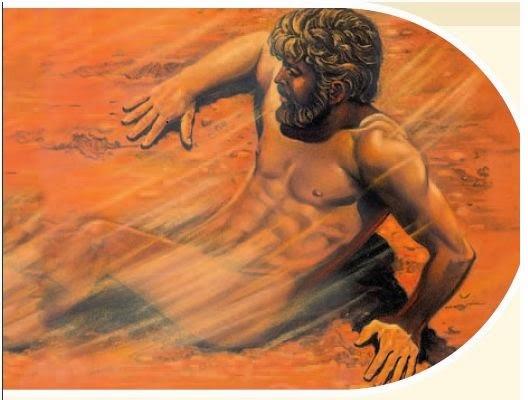
The Biblical writers recognized that the people among them with red skin were of an ancestral line of extreme antiquity. Some of these people were rulers in Edom. These are listed in Genesis 36. Esau the Elder and Esau the Younger were among them. Esau is specifically described as being red in Genesis 26.
The name Adam is derived from the root אדם (A.D.M), which is a verb meaning "to be red or ruddy" (Strong’s #119).
The Hebrew word for red is edom and it is a cognate to the Hausa word odum, meaning red-brown. Both are related to the word dam, meaning blood, and to the name of the first man Adam, who was formed from the red clay which washed down to the Upper Nile Valley from the Ethiopian highlands. These soils have a cambic B horizon. Chromic cambisols have a strong red brown color. It is evident then that the Upper Nile is the urheimat of the Adam and Eve story.
Jeff A. Benner, an expert on ancient Hebrew, explains:
We are all familiar with the name "Adam" as found in the book of Genesis, but what does it really mean? Let us begin by looking at its roots. This word/name is a child root derived from the parent דם meaning, "blood". By placing the letter א in front of the parent root, the child rootאדם is formed and is related in meaning to דם (blood).
By examing a few other words derived from the child root אדם we can see a common meaning in them all. The Hebrew word אדמה (adamah) is the feminine form of אדם meaning "ground" (see Genesis 2:7). The word/name אדום (Edom) means "red". Each of these words have the common meaning of "red". Dam is the "red" blood, adamah is the "red" ground, edom is the color "red" and adam is the "red" man. There is one other connection between "adam" and "adamah" as seen in Genesis 2:7 which states that "the adam" was formed out of the "adamah".
In the ancient Hebrew world, a person’s name was not simply an identifier but descriptive of one's character. As Adam was formed out of the ground, his name identifies his origins. (From here.)
Though the story of red Adam comes originally from the Upper Nile, the account was preserved by his Edomite descendants, one of whom was Abraham. Abraham's territory was between Hebron and Beersheba. As can be seen from the map below, his territory was entirely in the region of Edom. The people who lived there had a reddish skin tone. That is why the Greeks called this region Idumea, meaning "land of red people."
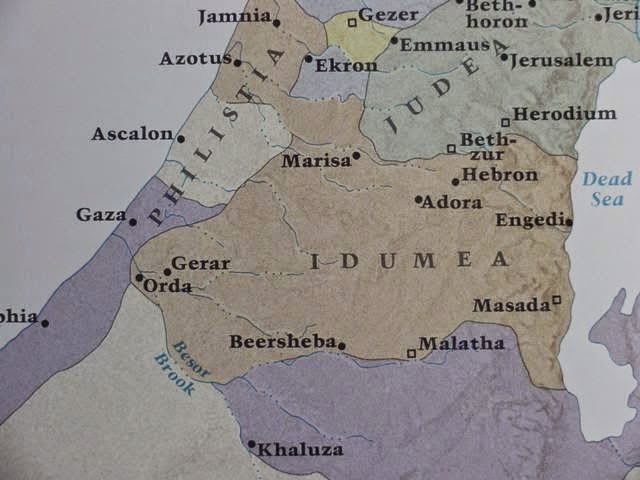
Isaac was Abraham's proper heir, and as such, he inherited Abraham's territory. Edom was under the control of Horites, what the Jews call their "Horim." Both Hebron (where Sarah lived) and Beersheba (where Keturah lived) are in Edom. Abraham's territory extended between the settlements of his two wives, and included mountains, lowlands wells, and the water system at Engedi.
David is related to the Horite rulers of Edom and he is described in the Bible as red/ruddy. Samuel, the son of a Horite priest from Ramah, anointed him ruler.
And Samuel said to Jesse, "Are these all the children?" And he said, "There remains yet the youngest, and behold, he is tending the sheep." Then Samuel said to Jesse, "Send and bring him; for we will not sit down until he comes here." So he sent and brought him in. Now he was ruddy, with beautiful eyes and a handsome appearance. And the LORD said, "Arise, anoint him; for this is he." Then Samuel took the horn of oil and anointed him in the midst of his brothers; and the Spirit of the LORD came mightily upon David from that day forward. And Samuel arose and went to Ramah. (1 Samuel 16:11- 13)
Here are images of people whose skin tone ranges from brown-red to red-brown
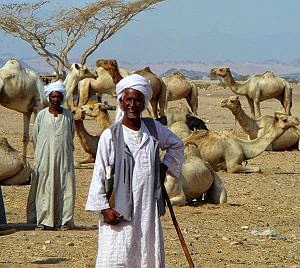
Beja of Sudan

Egyptian man in red
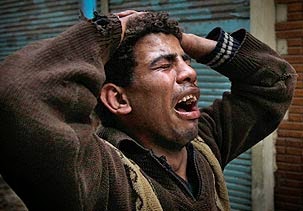
Grieving Egyptian
Note the reddish-brown skin tone
A red people is mentioned in African creation stories. It is said that God created the first human by mixing soil with his blood. This is circulated among the Igbo, for example, whose ancestors originated in the Upper Nile Valley. The Igbo belong to MtDNA haplogroup L1, believed to have first appeared approximately 150,000 to 170,000 years ago in East Africa.
.png)
The red descendants of the Proto-Saharans appear mainly to be in Haplogroup R1b, the point of origin of which was the wetlands extending from the Nile to Lake Chad. Lake Chad was Noah's homeland. It is shown above in the dark red area in Central Africa.
Some of Abraham's Horite Habiru ancestors can be traced back to the shrine city of Nekhen. One of the more intriguing discoveries at Nekhen was the recovery of an almost complete beard in association with the redheaded man in Burial no. 79. The facial hair of the man in Burial no. 79 had been trimmed with a sharp blade. The presence of long wavy natural red hair and a full beard suggests that this individual may have been Ainu (Annu). The Ainu were among Abraham's ancestors, and although they were widely dispersed before Abraham's time, the Nile Valley appears to be their point of origin. The Annu built the original shrine of Heliopolis which is called "Onn" in Genesis 41. Joseph married the daughter of the high priest on Onn.
The map shows that the red peoples extended into southwestern China. The Tarum mummies of China had red hair and beards. The oldest Tarum Mummies found in China date from 1900 B.C. The so-called "Ur-David" mummy (shown below) was tall and had red hair. This mummy, also called Cherchen Man or Chärchän Man, dates to about 1000 B.C.
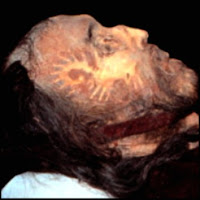
Note the solar mark on the face of this archaic ruler.
The 32 Signs of a Great Man (mahā purisa lakkhaṇa) are auspicious marks that are supposed to be present on the bodies of all Buddhas. Although only incidental to Buddhism, this idea is the theme of three discourses (D.II,142; M.II,133; Sn.103) and is mentioned briefly in several others. The idea of the Signs has its origins in Brahmanism and was incorporated into Buddhism at a later period for reasons that are not clear. Some of the Signs, like the long tongue, the blue eyes, the golden complexion and the ensheathed penis, were probably connected with the ancient Indian concept of idealized physical beauty. Others are so strange, grotesque even, that it is difficult to know what to make of them.
When the seer Asita came to visit the new born Buddha-to-be, Siddhattha Gotama, he mentions that he sees the signs or marks of a great man and lists some of them. This confirms that this concept is a pre-Buddhist idea.
It is very clear from the Tipitaka that the Buddha's physical appearance was normal in every way. When King Ajātasattu went to meet him he was unable to distinguish him from the disciples surrounding him (D.I,50). If the Buddha had any of the 32 Signs the king would have recognized him immediately. Pukkasāti sat talking to the Buddha for hours before realizing who he was (M.III,238). If the Buddha had any of the Signs the young man would have soon noticed it and known that he was someone unusual. When Upaka encountered the Buddha walking along the road to Gaya the thing he noticed most about him was 'clear faculities and radiant complexion' (M.I,170). He did not mention seeing any of the 32 Signs.
In the Buddha's teachings, the external and the physical are always subordinate to the internal and the psychological (S.I,169). The Buddha was aware of the Brahmanical concept that a ‘great man' could be known by his physical characteristics and he rejected this notion. Someone once asked him: ‘They talk about a ‘great man,' a ‘great man.' But what is it that makes a great man?' The Buddha replied: ‘It is by freeing the mind that someone becomes a great man. Without freeing the mind one cannot be a great man' (S.V,157).
32 Marks of the Great Man - Dhammawiki


No comments:
Post a Comment
Note: Only a member of this blog may post a comment.