This Blog is an Open Resource Containing Links, Commentary, Back Ups, and Research Into a Wide Variety of Topics and How They Can Connect to the Modern World: Alchemy, Astronomy, Astrology, Archeoastrology, Egyptology, Etymology, Gematria, History, Isopsephy, Numerology, Esoteric Knowledge, Occult, Magic, Gnosticism, and Many More. This blog features materials protected by the Fair Use guidelines of Section 107 of the Copyright Act. All rights reserved to copyright owners.
A ram horn is much like the Golden ratio. It is a logarithmic spiral which has a equation of r=e^(a*theta). The r is the distance from the orgin, e is the Eurlers numer (around 1.618282) and the theta is the angle mesured in radian. The horn is just like the squares in which is starts and increases at a consistent rate. You just add the past two measurements together, then you have the next numer in the sequence.
Or yobel {yob-ale'}; apparently from yabal; the blast of a horn (from its continuous sound); specifically, the signal of the silver trumpets; hence, the instrument itself and the festival thus introduced -- jubile, ram's horn, trumpet. see HEBREW yabal
In Hopi and Zuni dance rituals, Hú, also known as Huhuwa and Tithu, is the Kachina of the hummingbird.
The Hummingbird was, and is, an important bird in puebloan cultures. Hopi legend speaks of the Hummingbird as intervening on behalf of the Hopi people to convince the gods to bring rain. Even today Hummingbird feathers are highly prized and used ceremonially and in dance costumes. All Hummingbird Kachinas are depicted with a green mask and green moccasins. Hú dolls are carved from the root of the cottonwood tree.
During traditional ceremonies, the Hú dancer bobs while dancing and calls like a bird. His songs are prayers for rain to wet freshly planted crops in the spring, and women reward him with baskets of flowers; then they scatter to find him more flowers so the rain won't be scared away like a hummingbird might be scared away by a crowd.
The Hú dancer appears in both winter and spring ceremonies as well as the summer night dances in a lesser role.
These dances are often performed in underground ceremonial rooms which are only opened for the Hú dance.
Hu (mythology)
Hu (), in ancient Egypt, was the deification of the first word, the word of creation, that Atum was said to have exclaimed upon ejaculating or, alternatively, his self-castration, in his masturbatory act of creating the Ennead.
Hu is mentioned already in the Old Kingdom Pyramid texts (PT 251, PT 697) as companion of the deceased pharaoh. Together with Sia, he was depicted in the retinue of Thoth, with whom he was also occasionally identified.
In the Middle Kingdom, all gods participated in Hu and Sia, and were associated with Ptah who created the universe by uttering the word of creation. Hu was depicted in human shape, as a falcon, or as a man with a ram's head.
In the New Kingdom, both Hu and Sia together with Heke, Irer and Sedjem were members of the fourteen creative powers of Amun-Ra. By the time of Ptolemaic Egypt, Hu had merged with Shu (air).
Hu (surname)
Hu (胡) is a Chinese surname. In 2006, it was the 15th most common surname in China. In 2013, it was the 13th most common in China, with 13.7 million Chinese sharing this surname.
Some other less-common surnames pronounced Hu include 瓠, 護, 戶, 扈, 虎, 呼, 忽, 斛 and 壶. In Cantonese, “胡” is also pronounced as "Wu" or "Woo"
Hu (Sufism)
Hu or Huwa is a name for God in Sufism. Literally, Hebrew and Arabic for the English pronoun "He".
In Sufism Hu or Huwa is the pronoun used with Allah or God, and is used as a name of God. Allah Hu means "God, Just He!" In Arabic Allah means God and with Hu, as an intensive added to Allah, means "God himself." Hu is also found in the Islamic credo La Ilaha Ila Allah Hu: "There is no God but Allah," or in Sufi interpretation "There is no reality, except God", or in La Ilaha Ila Huwa meaning "There is no god but He".
hu ( Chinese: 壺; pinyin: hú) is a type of wine vessel that has a pear-shaped cross-section. Its body swells and flares into a narrow neck, creating S-shaped profile. While it is similar to you vessel, hu usually has a longer body and neck. The shape of hu probably derives from its ceramic prototype prior to the Shang dynasty (1600-1045 BC). They usually have handles on the top or rings attached to each side of neck. Many extant hu lack lids while those excavated in such tombs as Fu Hao's indicate that this type of vessel might be originally made with lids. Although it is more often to see hu having a circular body, there also appears hu in square and flat rectangular forms, called fang hu and bian hu 1 in Chinese. In addition, hu often came to be found in a pair or in a set together with other types of vessels. As wine had played an important part in the Shang ritual, the hu vessel might be placed in the grave of an ancestor as part of ritual in order to ensure a good relationship with ancestor's spirit.
The owl was a symbol for Athena, goddess of wisdom and strategy, before the Greeks gave their pantheon human forms. According to myth, an owl sat on Athena's blind side, so that she could see the whole truth. In Ancient Greece, the owl was a symbol of a higher wisdom, and it was also a guardian of the Acropolis.
Silver tetradrachm coin at the Museum of Fine Arts of Lyon depicting the owl of Athena (circa 480–420 BC). The inscription "ΑΘΕ" is an abbreviation of ΑΘΗΝΑΙΩΝ, which may be translated as "of the Athenians". In daily use the Athenian drachmas were called glaukes (γλαῦκες, owls). This silver coin was first issued in 479 BC in Athens after the Persians were defeated by the Greeks.
New Covenant
The entry of Caleb and Joshua to the Land of Israel symbolizes the secret of the New Covenant, and they, the 1st generation, could not enter because of unbelief (Hebrew 3:19).
32 paths of wisdom is 2 x 4 squared; 50 gates of understanding is 2 x 5 squared, and 72 bridges of knowledge is 2 x 6 squared, the formula is 2*n^2, where the n of wisdom is 4; the n of understanding is 5, and the n of knowledge is 6.
32 + 50 + 72 = 154, the gematria of World to Come עוֹלָם הַבָּא, as symbolized by Land of Israel.
4 + 5 + 6 + 154 = 169, which is 13 squared, i.e. the triad is one, Echad אֶחָד, the triad is one.
There is a higher knowledge and there is a lower knowledge. The higher knowledge is crown.
The gematria, in the order of ascent, i.e. understanding, wisdom, and crown, is 929:
929 is exactly the gematria of New Covenant, בְּרִית חֲדָשָֽׁה, which is also the gematria of “Mashiach to Israel” מָּשִׁיחַ לְיִשְׂרָאֵל, meaning the New Covenant is the revelation of Mashiach to Israel.
OLAM HA-BA (Heb. עוֹלָם הַבָּא). The term olam ha-ba (literally, "the coming world") in contrast to olam ha-zeh (liter-ally "this world") refers to the hereafter, which begins with the termination of man's earthly life. Source
Trisecting The Angle With Only Compass and Straight Edge
NEW DISCOVERY (7-25-21): Trisecting the Angle with only a Compass and Straight Edge (and NO MEASUREMENTS).
The 'Third' of the "IMPOSSIBLE CONSTRUCTIONS" using only a Compass and Straight Edge (1. Squaring the Circle; 2. Doubling the Cube; 3. Trisecting the Angle). Trisecting an Angle is POSSIBLE but is solved ONLY through the Wisdom of the Owl. While attending the large Eye 👁 Conference held in Las Vegas over the weekend, I stayed at a hotel immediately adjacent to the Golden Luxor Pyramid and gave a presentation (on a Project called "Third Eye" to the world's leading Eye Surgeons (Ophthalmologists)).....interesting that the Trisection of the Angle makes both "Three Eyes" and and literally looks just like an Egyptian 'Pharaoh Eagle Owl'.... 🧐.
This Trisection technique works on all angle sizes...
Sophia (Koinē Greek: σοφία sophía "wisdom") is a central idea in Hellenistic philosophy and religion, Platonism, Gnosticism and Christian theology. Originally carrying a meaning of "cleverness, skill", the later meaning of the term, close to the meaning of Phronesis ("wisdom, intelligence"), was significantly shaped by the term philosophy ("love of wisdom") as used by Plato.
In the Orthodox Church and the Roman Catholic Church, the feminine personification of divine wisdom as Holy Wisdom (Ἁγία Σοφία Hagía Sophía) can refer either to Jesus Christ the Word of God (as in the dedication of the church of Hagia Sophia in Constantinople) or to the Holy Spirit.
References to Sophia in Koine Greek translations of the Hebrew Bible translate to the Hebrew term Chokhmah.
In Dharmic culture, the tilaka (Sanskrit: तिलक) is a mark worn usually on the forehead at the most important chakra on the body called Ajna chakra, sometimes other parts of the body such as neck, hand, chest and arms. Tilaka may be worn daily or for rites of passage or special spiritual and religious occasions only, depending on regional customs.
The term also refers to the Hindu ritual of marking someone's forehead with a fragrant paste, such as of sandalwood or vermilion, as a welcome and expression of honour when they arrive.
But in history, tilak was also used by other Dharmic cultures like Buddhism, Jainism and Sikhism as they were influenced by Hinduism and its spiritual and philosophical beliefs.
The tilaka is a mark created by the application of powder or paste on the forehead. Tilakas are vertical markings worn by Vaishnavites (a sect of Hinduism) . The Vaishnava tilaka consists of a long vertical marking starting from just below the hairline to almost the end of one's nose tip, and they are also known as Urdhva Pundra. It is intercepted in the middle by an elongated U. There may be two marks on the temples as well. This tilaka is traditionally made with sandalwood paste.
The other major tilaka variant is often worn by the followers of Shiva, known by the names of Rudra-tilaka and Tripundra.[3][4] It consists of three horizontal bands across the forehead with a single vertical band or circle in the middle. This is traditionally done with sacred ash from fire sacrifices. This variant is the more ancient of the two and shares many common aspects with similar markings worn across the world.
Significance
Chapter 2 of the Kalagni Rudra Upanishad, a Shaiva traditional text, explains the three lines of a Tilaka as a reminder of various triads: three sacred fires, three syllables in Om, three gunas, three worlds, three types of atman (self), three powers in oneself, first three Vedas, three times of extraction of the Vedic drink Soma.
The first line is equated to Garhapatya (the sacred fire in a household kitchen), the A syllable of Om, the Rajas guna, the earth, the external self, Kriyā – the power of action, the Rigveda, the morning extraction of Soma, and Maheshvara.
The second streak of ash is a reminder of Dakshinagni (the holy fire lighted in the South for ancestors), the sound U of Om, Sattva guna, the atmosphere, the inner self, Iccha – the power of will, the Yajurveda, midday Soma extraction, and Sadashiva.
The third streak is the Ahavaniya (the fire used for Homa), the M syllable in Om, the Tamas guna, Svarga – heaven, the Paramatman – the highest self (the ultimate reality of Brahman), Jnana – the power of knowledge, the Samaveda, Soma extraction at dusk, and Shiva.
These lines, represent Shiva's threefold power of will (icchāśakti), knowledge (jñānaśakti), and action (kriyāśakti). The Tripuṇḍra described in this and other Shaiva texts also symbolises Shiva's trident (triśūla) and the divine triad of Brahmā, Vishnu, and Shiva.
The Vasudeva Upanishad, a Vaishnava tradition text, similarly explains the significance of three vertical lines in Urdhva Pundra Tilaka to be a reminder of Brahma, Vishnu, Shiva; the Vedic scriptures – Rigveda, Yajurveda and Samaveda; three worlds Bhu, Bhuva, Svar; the three syllables of Om – A, U, M; three states of consciousness – awake, dream sleep, deep sleep; three realities – Maya, Brahman and Atman; the three bodies – Sthula, Sukshma, and Karana.
Om or About this sound aum (help·info) (written universally as ॐ; in Devanagari as ओं oṃ [õː], औं auṃ [ə̃ũ], or ओम् om [õːm]) is a mystical Sanskrit sound of Hindu origin, sacred and important in various Dharmic religions such as Hinduism, Buddhism and Jainism. The syllable is also referred to as omkara (ओंकार oṃkāra) or aumkara (औंकार auṃkāra), literally "om syllable", and in Sanskrit it is sometimes referred to as प्रणव (praṇava), literally "that which is sounded out loudly".
Om is also written ओ३म् (ō̄m [õːːm]), where ३ is प्लुत (pluta, "three times as long"), indicating a length of three morae (that is, the time it takes to say three syllables)—an overlong nasalized close-mid back rounded vowel—though there are other enunciations adhered to in received traditions.
(This is the symbol found in the Crown Chakra).
The syllable "om" is first described as all-encompassing mystical entity in the Upanishads. Today, in all Hindu art and all over India and Nepal, 'om' can be seen virtually everywhere, a common sign for Hinduism and its philosophy and theology. Hindus believe that as creation began, the divine, all-encompassing consciousness took the form of the first and original vibration manifesting as sound "OM".[3] Before creation began it was "Shunyākāsha", the emptiness or the void. Shunyākāsha, meaning literally "no sky", is more than nothingness, because everything then existed in a latent state of potentiality. The vibration of "OM" symbolizes the manifestation of God in form ("sāguna brahman"). "OM" is the reflection of the absolute reality, it is said to be "Adi Anadi", without beginning or the end and embracing all that exists.[3] The mantra "OM" is the name of God, the vibration of the Supreme. When taken letter by letter, A-U-M represents the divine energy (Shakti) united in its three elementary aspects: Bhrahma Shakti (creation), Vishnu Shakti (preservation) and Shiva Shakti (liberation, and/or destruction).
The syllable is mentioned in all the Upanishads, specially elaborated upon in the Taittiriya, Chāndogya and Māndukya Upanishad set forth as the object of profound religious meditation, the highest spiritual efficacy being attributed not only to the whole word but also to the three sounds a (a-kāra), u (u-kāra), m (ma-kāra), of which it consists. A-kara means form or shape like earth, trees, or any other object. U-kāra means formless or shapeless like water, air or fire. Ma-kāra means neither shape nor shapeless (but still exists) like the dark energy content of the Universe. When we combine all three syllables we get AUM which is a combination of A-kāra, U-kāra, and Ma-kāra.
In Advaita philosophy it is frequently used to represent three subsumed into one, a triune, a common theme in Hinduism. It implies that our current existence is mithyā and maya, "falsehood", that in order to know the full truth we must comprehend beyond the body and intellect the true nature of infinity. Essentially, upon moksha (mukti, samādhi) one is able not only to see or know existence for what it is, but to become it. When one gains true knowledge, there is no split between knower and known: one becomes knowledge/consciousness itself. In essence, Om is the signifier of the ultimate truth that all is one.
Or yobel {yob-ale'}; apparently from yabal; the blast of a horn (from its continuous sound); specifically, the signal of the silver trumpets; hence, the instrument itself and the festival thus introduced -- jubile, ram's horn, trumpet. see HEBREW yabal
Our schools and churches do not tell us everything. They don’t tell us even the simplest things; things like the Earth-Moon system matches the geometry of a hen’s egg and that both are a containment property of the golden mean, Φ = (√5 + 1) / 2.
While we don’t hear much about it today (actually nothing about it), knowledge of this ‘cosmic egg’ geometry was apparently well known in the ancient world. The ancient Egyptian fable The Goose That Laid the Golden Eggs speaks of this wisdom in philosophical terms long before Aesop wrote his fables. But the Great Pyramid of Khufu made it real. This triangular building was once a temple to the Earth-Moon egg, celebrating the golden mean in nature for all to see. The ancient Egyptian Naga knew that this ‘divine proportion’ contained everything and all things originated from it, bringing the world into a fine balance for life to evolve.
Golden Egg Equation
The truth is the entire solar system is a series of such eggs – nested one within another like a giant Russian Matryoshka doll – all resonating out of the Sun’s golden heliospheric spiral. We live inside this solar Matryoshka – growing in the yolk of an enormous fractal egg laid by the Milky Way. We wait to hatch, yet most wait completely unaware.
Music of Spheres Model
Why are we not told of this in our science classes? Why is this not mentioned in any documentary, written about in Popular Science or spoken of in our churches?
The answer is it would conflict with the ‘complicity of convenience’ between Science and Religion (begun 350 years ago during ‘The Enlightenment’) to avoid any mention of natural ‘pagan’ harmonic principles. For to mention such things would be to admit that life is purposeful in the cosmos and divinity can be found right there in nature. Such a worldview would conflict with the deeply entrenched scientific view of randomness and meaninglessness in all things and would threaten the well-defended Darwinian assumption that life emerged entirely by accident. It would also conflict with the Holy Roman Empire’s thousand year crusade to separate mankind from nature, enforcing social control through psychological and political means. No, we must not say a word, lest we bring down the teetering architecture of Western civilization.
So it seems, for now, that truth is less important than control and the status quo. Yet, hatch we must from our self-imposed blindness deep inside the eggshell; a spiritual evolution far beyond anything physical.
The writer, who goes by the name of Dionysius Areopagita, teaches that the highest spiritual truth is revealed only to those who have transcended every ascent of every holy height, and have left behind all divine lights and sounds and heavenly discoursing, and have passed into that Darkness where HE really is (as saith the Scripture) who is ALL, above all things.
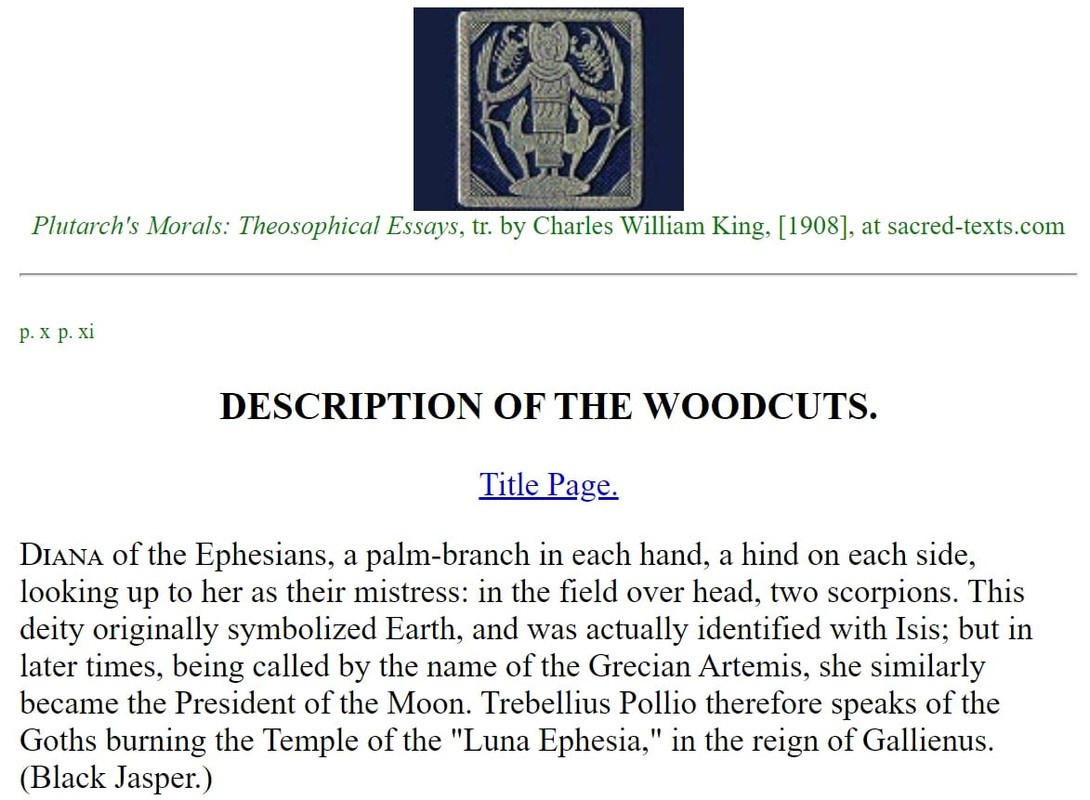
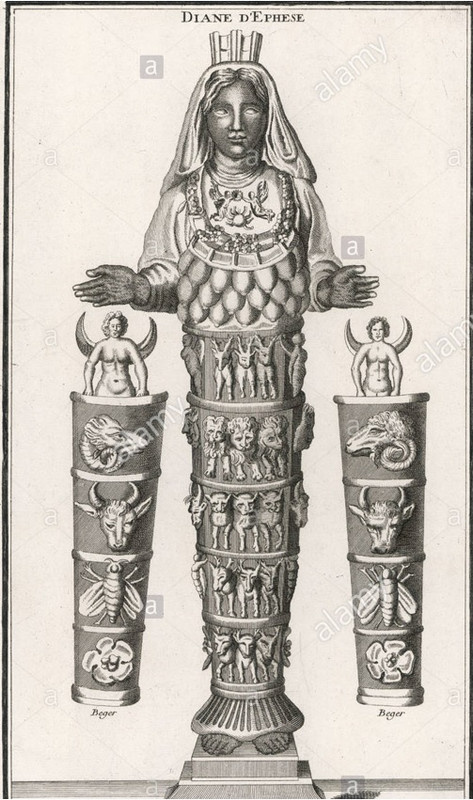
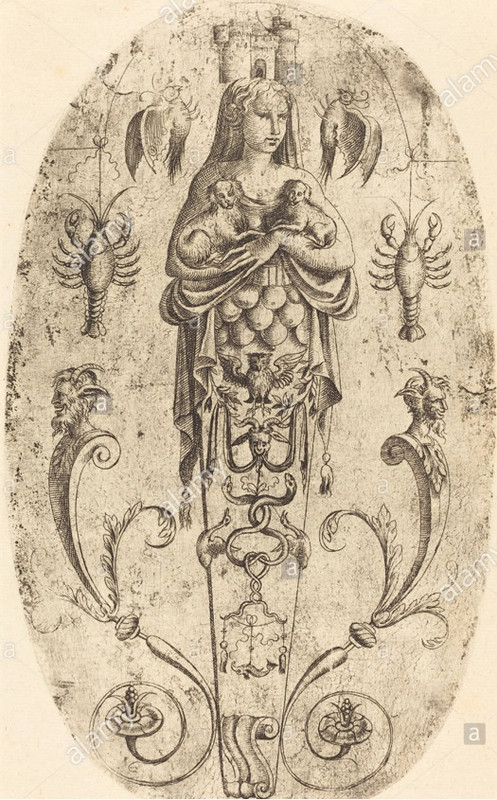
The words graven upon the zone and the feet of the Ephesian Diana, which Hesychius has preserved, are the following:
Aski-Kataski = 'Darkness--Light'
Haix-Tetrax = 'Himself'
interpreted as
Damnameneus = 'The Sun'
Aision = 'Truth'
'These Ephesian words', says Plutarch (Sympos), 'the Magi used to recite over those possessed with devils.' 'Damnameneus' is seen on a Gnostic amulet in the De la Turba Collection (The Gnostics, p. 94).
The Argha had the form of a crescent. The Argo, arc, or arche, is the navis biprora. It is clear that, as neither the full moon nor the half-moon was ever the object of worship, it is the crescent horns of the moon which imply the significance. These mean the woman-deity in every religion.
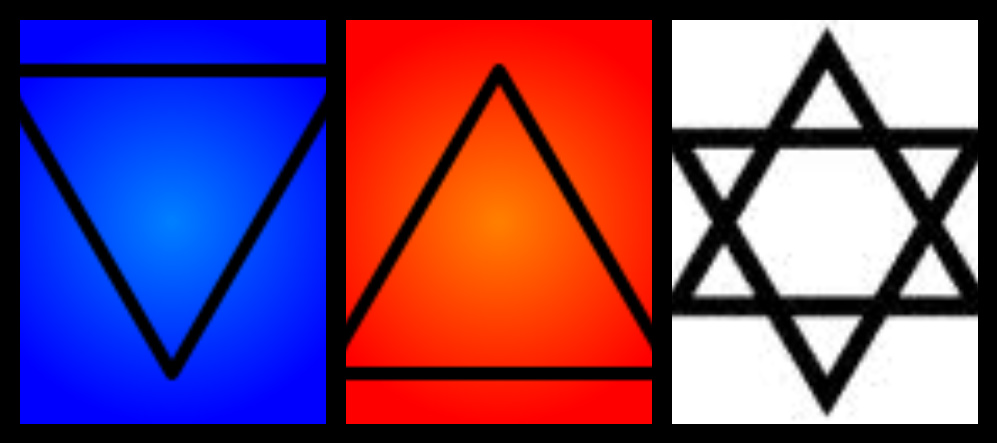
The snake associated with the mysteries among the Hindoos is the cobra-di-capella. It is said that the snake on the heads of all the Idols in Egypt was a Cobra. The name of the monarch or Chief Priest in Thibet is the Lama, or the Grand Lama. Prester-John is the great Priest, or Prestre (Prêtre), Ian, Ion, Jehan, or John (the Sun). Lamia is the 'snake' among the Ophidians; Lama is the hand: lamh, hand, is a divine name in the Scythian tongue. It also means the number 10, and the Roman numeral X, which is a cross. Now, the double pyramid, or hand, (a) △, of the Egyptians comprises the mystic mark signifying the two original principles water and fire, as above--(b)--the union of which, as intersecting triangles, forms the famous Hexalpha, or 'Solomon's Seal', or 'Wizard's Foot', which, according to the Eastern allegory, is placed (as that of St. Michael) upon the Rebellious Spirits in their 'abyss', or 'prison'.
Pyr is the Greek name of fire (thence Pyramid), and mythologically of the sun, who was the same as Hercules. And the great analyser of mythology assures us that Pur was the ancient name of Latian Jupiter, the father of Hercules; that he was the deity of fire; that his name was particularly retained amongst the people of Præneste, who had been addicted to the rites of fire. Fire, in short, in these mythologies, as also in all the Christian churches, meets us at every turn. But we must not mix up heathen ideas and Christian ideas in these matters.
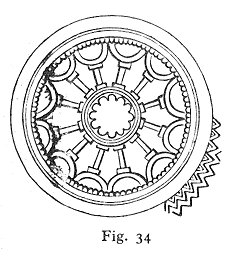
OUR engraving borrows from the West Front of Laon Cathedral, France, a Catherine-Wheel (or 'Rose') Window. The twelve pillars, or radii, are the signs of the Zodiac, and are issuant out of the glorified centre, or opening 'rose'--the sun, or 'beginning of all things'. 'King Arthur’s Round Table' displays the 'crucified' Rose in its centre.
In the 'tables' (Tablier, Fr. = Apron), alternating with tying-knots, of the Order of the Garter--which 'Most Noble Order' was originally dedicated, be it remembered, to the Blessed Lady, or to the Virgin Mary--the microcosmical, miniature 'King Arthur’s Round Table' becomes the individual female discus, or organ, waxing and waning, negative or in flower, positive or natural, alternately red and white, as the Rose of the World: Rosamond, Rosa mundi. And here we will adduce, as our justification for this new reading of the origin of the Order of the Garter, the very motto of the princely order itself:
Honi soit qui mal y pense!
or,
'YONI' soit qui mal y pense!
What this 'Yoni' is, and the changes meant and apotheosized through it, the discreet reader will see on a little reflection.
All the world knows the chivalric origin of this Most Noble Order of the Garter 1. It arose in a princely act--rightly considered princely, when the real, delicate, inexpressibly high-bred motive and its circumstances are understood, which motive is systematically and properly concealed. Our great King Edward the Third picked up, with the famous words of the motto of the Order of the Garter, the 'garter'--or, as we interpret it, by adding a new construction with hidden meanings, the 'Garder' (or special cestus, shall we call it?)--of the beautiful and celebrated Countess of Salisbury, with whom, it is supposed, King Edward was in love.
The following is from Elias Ashmole: 'The Order of the Garter by its motto seems to challenge inquiry and defy reproach. Everybody must know the story that refers the origin of the name to a piece of gallantry: either the Queen or the Countess of Salisbury having been supposed to have dropped one of those very useful pieces of female attire at a dance; upon which old Camden says, with a great deal of propriety, and a most just compliment to the ladies, "Hæc vulgus perhibet, nec vilis sane hæc videatur origo, cum NOBILITAS sub AMORE jacet." The ensign of the order, in jewellery or enamel, was worn originally on the left arm. Being in the form of a bracelet to the arm, it might possibly divert the attention of the men from the reputed original; it might be dropped and resumed without confusion; and the only objection I can see to the use of such an ornament is the hazard of mistake from the double meaning of the term periscelis, which signifies not only a garter, but breeches, which our English ladies never wear: "Quæ Græci περισχελῆ vocant, nostri Braccas" (braces or breeches) "dicunt", says an ancient Father of the Church.' The Garter, to judge thus from Camden, was not a garter at all for the leg, but an occasional very important item of feminine under-attire; and King Edward's knightly feeling, and the religious devotion of the object, will be perceived upon close and delicately respectful consideration.
There is great obscurity as to the character of Abraxas, the divinity of the Gnostics. The Eons, or Degrees of Advance in the Zodiacal Circle, are thirty in number to each of the Twelve Signs, and consequently there are 360 to the entire Astronomical Circle, or 365, counting for each day of the solar year. The inscription upon the Gnostic gems, CΕΟΥ, is probably intended for ΘΕΟΥ; 'for the Arabs yet substitute the s for the th in their pronunciation' (Gnostics, p. 233; Matter, Histoire Critique du Gnosticisme). In this 's', and the 'th' standing for it, lie all the mysteries of Masonry.
+, Christos, was designed for the guide of all that proceeds from God. Sophia-Achamoth is the guide, according to the Gnostics, for all proceeding out of 'matter'. St. Irenæus, whose period is the end of the second century, draws all these startling inferences from the Book of Enoch, and names 'Sophia' as signifying the Divine Wisdom. The Ophite scheme seems evidently the Bhuddistic Bythos, answering to the first Buddha. Sige, Sophia, Christos, Achamoth, Ildabaoth, answer to the successive five others (Gnostics,
p. 181
p. 27; Bellermann’s Drei Programmen über die Abraxasgemmen, Berlin, 1820; Basilides; Tertullian; De Præscript.: 'Serpentem magnificant in tantum, ut ilium etiam Christo præferant.' See Tertullian, Epiphanius, and Theodoret.: St. John iii. 14, also). We now refer the reader to some significant figures towards the end of our volume, which will be found according to their numbers.
Figure 289: The Abraxas-god, invested with all the attributes of Phœbus. Green jasper; a unique type. The Egyptians call the moon the mother of the world, and say it is of both sexes (Plutarch; Spartian, Life of Caracalla). The moon, in a mystic sense, is called by the Egyptians male and female. The above is a gem in the Bosanquet Collection. In the exerque is the address, CΑΒΑΩ, 'Glory unto Thee!' On the reverse, in a cartouche formed by a coiled asp--precisely as the Hindoos write the ineffable name 'Aum'--are the titles ΙΑΩ.ΑΒΡΑCΑΞ (The Gnostics, p. 86).
Figure 311 represents Venus standing under a canopy supported on twisted columns, arranging her hair before a mirror held up by a Cupid; two others hover above her head, bearing up a wreath. In the field, ΦΑΣΙΣ ΑΡΙΩΡΙΦ--'The Manifestation of Arioriph'. Venus here stands for the personification of the Gnostic Sophia, or Achamoth, and as such is the undoubted source of our conventional representation of Truth (Montfauçon, pl. clxi). Reverse, figure 312, which represents Harpocrates seated upon the lotus, springing from a double lamp, formed of two phalli united at the base. Above his head is his title 'Abraxas', and over that is the name 'Iao'. In the field are the seven planets. The sacred animals--the scarab, ibis, asp, goat, crocodile, vulture, emblems of so many deities (viz. Phre, Thoth, Isis, Merides, Bebys, Neith)--the principal in the Egyptian mythology, arranged by threes, form a frame to the design. Neatly engraved on a large, bright loadstone (The Gnostics, p. 211).
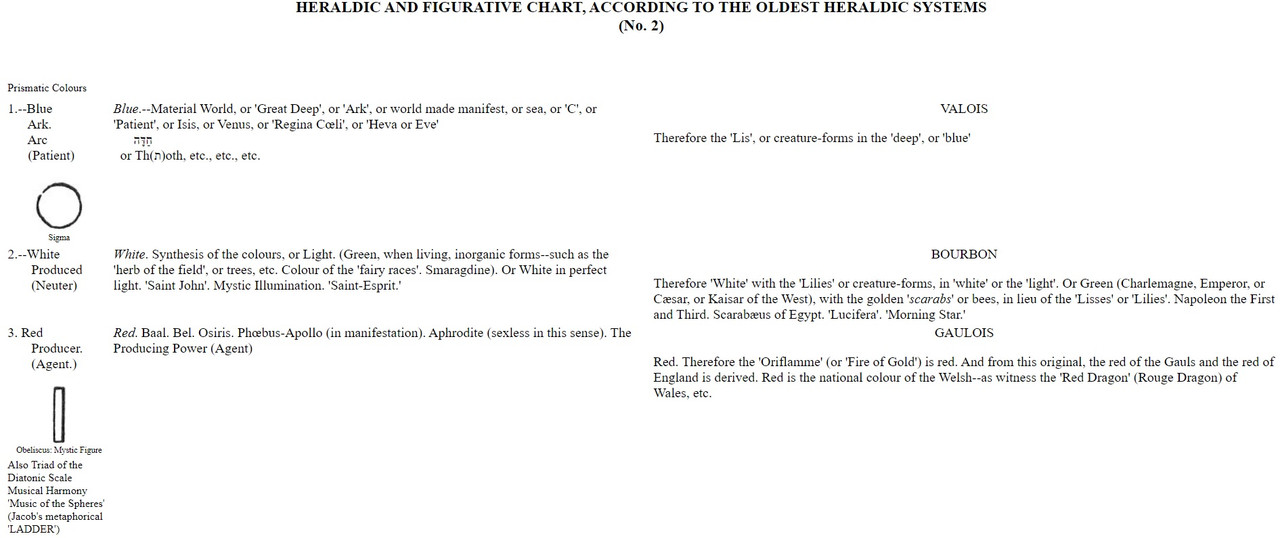
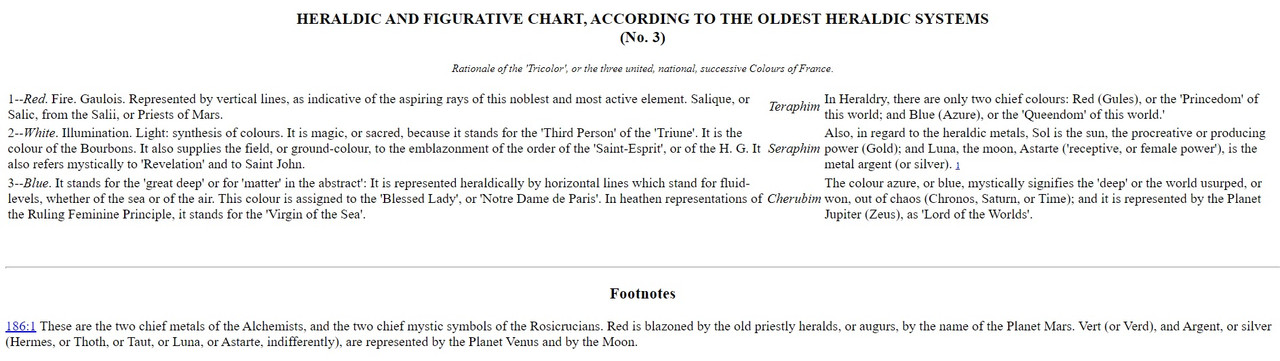
From the above cabalistic estimate of the virtues of colours, it happens that the colour blue (sky-blue) is chosen as the colour for the investiture of infants at baptism, and as the colour for children's coffins. Blue or white (not white as meaning the 'S.S.' in the sacred sense, but white as the synthesis of material elements, or of light, or of 'sinlessness in irresponsibility') are children's colours at other times. There were two great ordeals--by water, and by fire. The one is the occult trial-baptism by water in the sinister or left-handed sense, applied to those suspected of witchcraft. The other (more perfect and more perfecting) baptism is by symbolical fire. Both rites were in use among the Egyptians. (Refer to mystic heraldic formulæ elsewhere in our book.) The three ordeals (or sacraments) of the Ancient Mysteries were by 'Water, Air, and Fire'. Thus, also, the Egyptian Initiations: 'Cave, Cloud, Fire'. So, too, the Masonic Initiations. With these meanings, royal coffins and investitures are always red (Mars), as meaning 'royalty active'; or imperial purple (Jupiter, or perhaps Mercurius--Thoth, Taut, Tat), as 'royalty passive', or implying the 'lord of regions'.
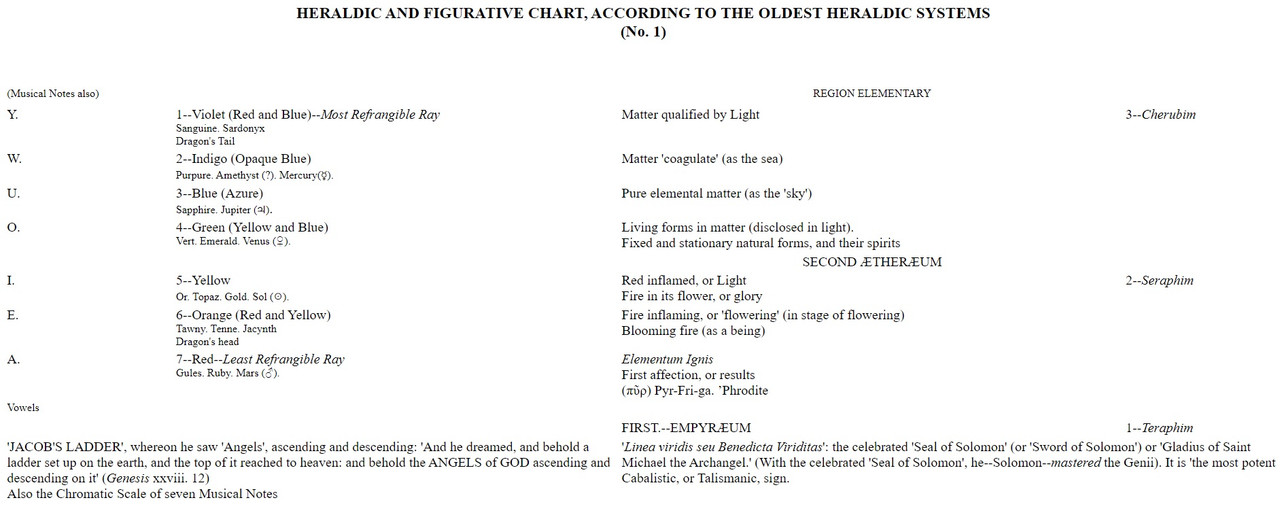
According to the cabalistic view, 'Jacob's 'Ladder', which was disclosed to him in a vision, is a metaphorical representation of the powers of alchemy, operating through visible nature. The 'Ladder' was a 'Rainbow', or prismatic staircase, set up between earth and heaven. Jacob's Dream implied a history of the whole hermetic creation. There are only two original colours, red and blue, representing 'spirit' and 'matter'; for orange is red mixing with the yellow light of the sun, yellow is the radiance of the sun itself, green is blue and yellow; indigo is blue tinctured with red, and violet is produced by the mingling of red and blue. The sun is alchemic gold, and the moon is alchemic silver. In the operation of these two potent spirits, or mystic rulers of the world, it is supposed astrologically that all mundane things were produced.
The next following pages explain the mystic analogy between colours, language; music, and the seven angelic adverse intelligences, supposed by the Gnostics to be operative in the 'dissonance of creation'. These represent the descending half of the 'Machataloth', as the cabalistic Jews called the Zodiac united. The whole is made up from abstruse sigmas, or the application of Rosicrucianism on its hieroglyphic and representative side.