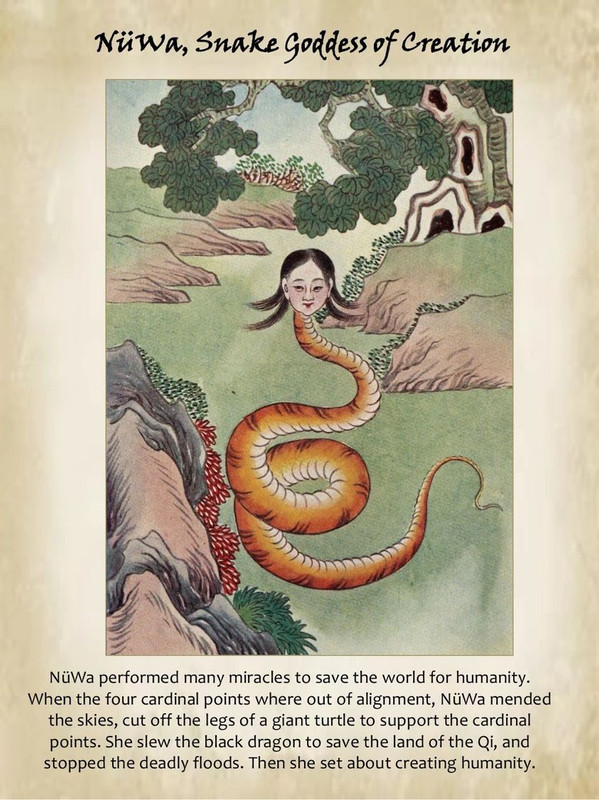
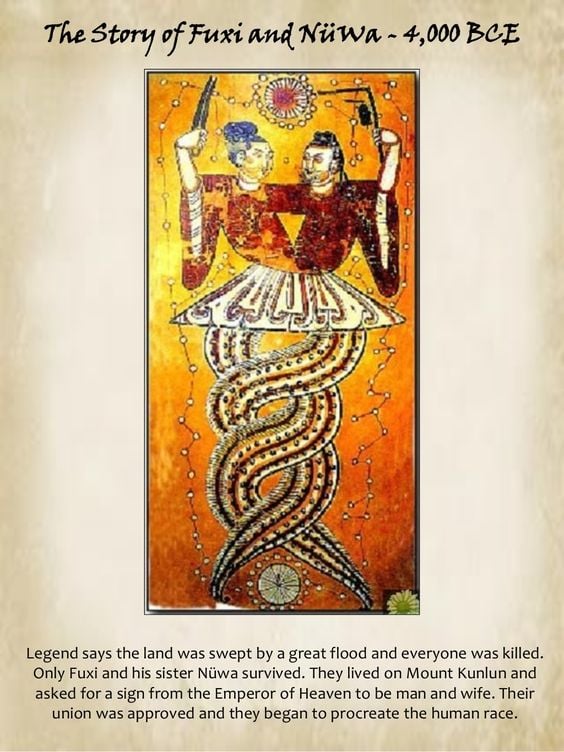
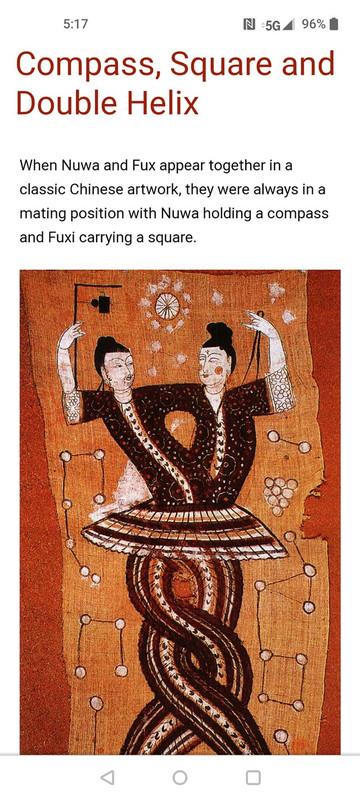
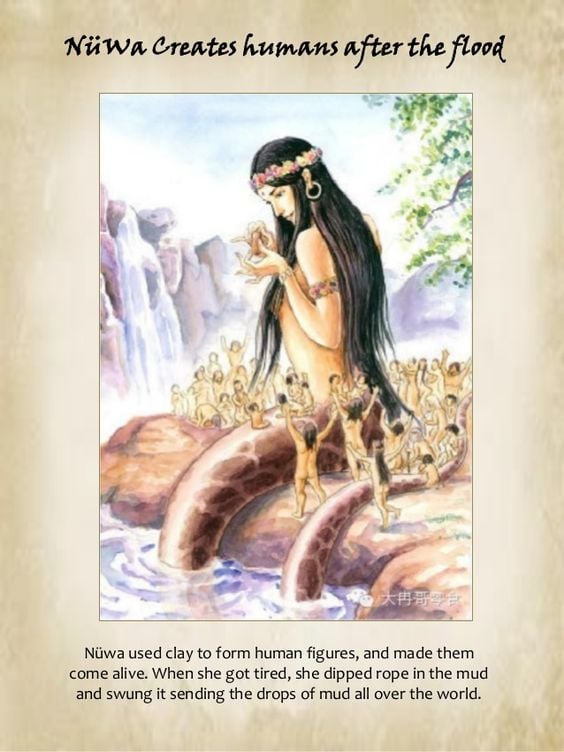
Nüwa, also read Nügua, is the mother goddess of Chinese mythology, the sister and wife of Fuxi, the emperor-god. She is credited with creating humanity and repairing the Pillar of Heaven.
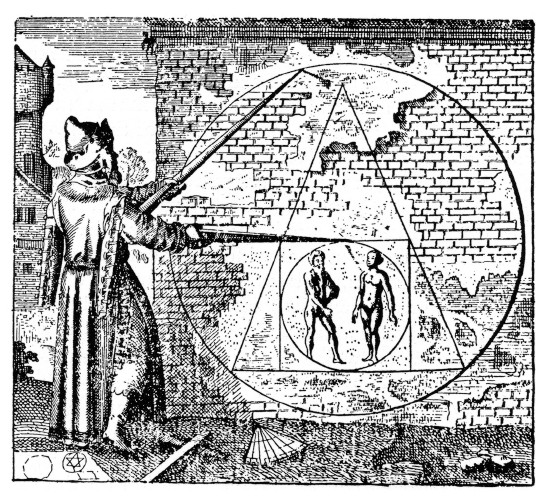
The character nü (Chinese: 女; lit. 'female') is a common prefix on the names of goddesses. The proper name is wa, also read as gua (Chinese: 媧). The Chinese character is unique to this name. Birrell translates it as 'lovely', but notes that it "could be construed as 'frog', which is consistent with her aquatic myth.[2] In Chinese, the word for 'whirlpool' is wo (Chinese: 渦), which shares the same pronouce with the word for 'snail' (Chinese: 蝸). These characaters all have their each right side constructed by the word wa (Chinese: 咼), which can be translated as 'spiral' or 'helix' as noun, and as 'spin' or 'rotate' when as verb, to describe the 'helical movement'. This mythical meaning has also been symbolic pictured as a compasses in hand which can be found on many paintings and portraits associated with her.
Her reverential name is Wahuang (Chinese: 媧皇; lit. 'Empress Wa').
The Huainanzi relates Nüwa to the time when Heaven and Earth were in disruption:
Going back to more ancient times, the four pillars were broken; the nine provinces were in tatters. Heaven did not completely cover [the earth]; Earth did not hold up [Heaven] all the way around [its circumference]. Fires blazed out of control and could not be extinguished; water flooded in great expanses and would not recede. Ferocious animals ate blameless people; predatory birds snatched the elderly and the weak. Thereupon, Nüwa smelted together five-colored stones in order to patch up the azure sky, cut off the legs of the great turtle to set them up as the four pillars, killed the black dragon to provide relief for Ji Province, and piled up reeds and cinders to stop the surging waters. The azure sky was patched; the four pillars were set up; the surging waters were drained; the province of Ji was tranquil; crafty vermin died off; blameless people [preserved their] lives.
The catastrophes were supposedly caused by the battle between the deities Gonggong and Zhuanxu (an event that was mentioned earlier in the Huainanzi),[b] the five-colored stones symbolize the five Chinese elements (wood, fire, earth, metal, and water), the black dragon was the essence of water and thus cause of the floods, Ji Province serves metonymically for the central regions (the Sinitic world). Following this, the Huainanzi tells about how the sage-rulers Nüwa and Fuxi set order over the realm by following the Way (道) and its potency (德).
Fuxi or Fu Hsi (伏羲 ~ 伏犧 ~ 伏戲)[a][1] is a culture hero in Chinese legend and mythology, credited along with his sister and wife Nüwa with creating humanity and the invention of music,[2] hunting, fishing, domestication, and cooking as well as the Cangjie system of writing Chinese characters around 2,000 BCE. Fuxi was counted as the first of the Three Sovereigns at the beginning of the Chinese dynastic period.
Pangu was said to be the creation god in Chinese mythology. He was a giant sleeping within an egg of chaos. As he awoke, he stood up and divided the sky and the earth. Pangu then died after standing up, and his body turned into rivers, mountains, plants, animals, and everything else in the world, among which is a powerful being known as Huaxu (华胥). Huaxu gave birth to a twin brother and sister, Fuxi and Nüwa. Fuxi and Nüwa are said to be creatures that have faces of human and bodies of snakes.
Fuxi was known as the "original human", and he was said to have been born in the lower-middle reaches of the Yellow River in a place called Chengji (成纪) (possibly modern Lantian, Shaanxi province, or Tianshui, Gansu province).
A possible historical interpretation of the myth is that Huaxu (Fuxi's mother) was a leader during the matriarchal society (c. 2,600 BC) as early Chinese developed language skill while Fuxi and Nüwa were leaders in the early patriarchal society (c. 2,600 BCE) while Chinese began the marriage rituals.
According to the Classic of Mountains and Seas, Fuxi and Nüwa were the original humans who lived on the mythological Kunlun Mountain (today's Huashan). One day they set up two separated piles of fire, and the fire eventually became one. Under the fire, they decided to become husband and wife. Fuxi and Nüwa used clay to create offspring, and with the divine power they made the clay figures come alive.[4] These clay figures were the earliest human beings. Fuxi and Nüwa were usually recognized by Chinese as two of the Three Sovereigns in the early patriarchal society in China (c. 2,600 BCE), based on the myth about Fuxi establishing marriage ritual in his tribe. The creation of human beings was a symbolic story of having a larger family structure that included the figure of a father.
On one of the columns of the Fuxi Temple in Gansu Province, the following couplet describes Fuxi's importance: "Among the three primogenitors of Huaxia civilization, Fu Xi in Huaiyang Country ranks first."[4] During the time of his predecessor Nüwa, society was matriarchal.
古之時未有三綱、六紀,民人但知其母,不知其父,能覆前而不能覆後,臥之言去言去,起之吁吁,饑即求食,飽即棄余,茹毛飲血而衣皮葦。於是伏羲仰觀象於天,俯察法於地,因夫婦正五行,始定人道,畫八卦以治下。
In the beginning there was as yet no moral or social order. Men knew their mothers only, not their fathers. When hungry, they searched for food; when satisfied, they threw away the remnants. They devoured their food hide and hair, drank the blood, and clad themselves in skins and rushes. Then came Fu Xi and looked upward and contemplated the images in the heavens, and looked downward and contemplated the occurrences on earth. He united man and wife, regulated the five stages of change, and laid down the laws of humanity. He devised the eight trigrams, in order to gain mastery over the world.
— Ban Gu, Bai Hu Tongyi
Fuxi taught his subjects to cook, to fish with nets, and to hunt with weapons made of bone, wood, or bamboo. He instituted marriage and offered the first open-air sacrifices to heaven. A stone tablet, dated AD 160, shows Fuxi with Nüwa.
Traditionally, Fuxi is considered the originator of the I Ching, which work is attributed to his reading of the He Map (or the Yellow River Map). According to this tradition, Fuxi had the arrangement of the trigrams of the I Ching revealed to him in the markings on the back of a mythical dragon horse (sometimes said to be a tortoise) that emerged from the Luo River. This arrangement precedes the compilation of the I Ching during the Zhou dynasty. This discovery is said to have been the origin of calligraphy. Fuxi is also credited with the invention of the Guqin musical instrument, though credit for this is also given to Shennong and Yellow Emperor.
The Figurists viewed Fuxi as Enoch, the Biblical patriarch.
Fuxi is said to have lived for 197 years altogether and died at a place called Chen (modern Huaiyang, Henan), where a monument to him can still be found and visited as a tourist attraction.
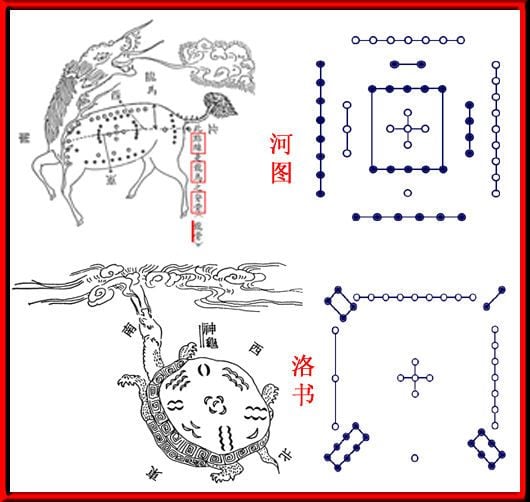
The Mystery Contained in the Book of Hetuluo
The peculiarity of the river map is that it uses simple elements such as black and white, numbers, and patterns to explain the universe. The astrology in the sky corresponds to the position of the ground, each position is composed of yin and yang, and the attributes of these five positions constitute the circulation of circulation. This is how everything works in Ning Zhou, and it is also the origin of the universe. Therefore, He Tu is again regarded as the innate ontology cosmos diagram.
Through observation, it can be found that the rotation of the numbers in the river chart is regular. The odd numbers 1, 3, 5, 7, and 9 rotate clockwise, while the even numbers 2, 4, 6, 8, and 10 also rotate clockwise. The attributes of the five elements corresponding to each orientation also rotate clockwise and counterclockwise. It's just against each other. The map of the river seems to show certain laws of the universe's operation.
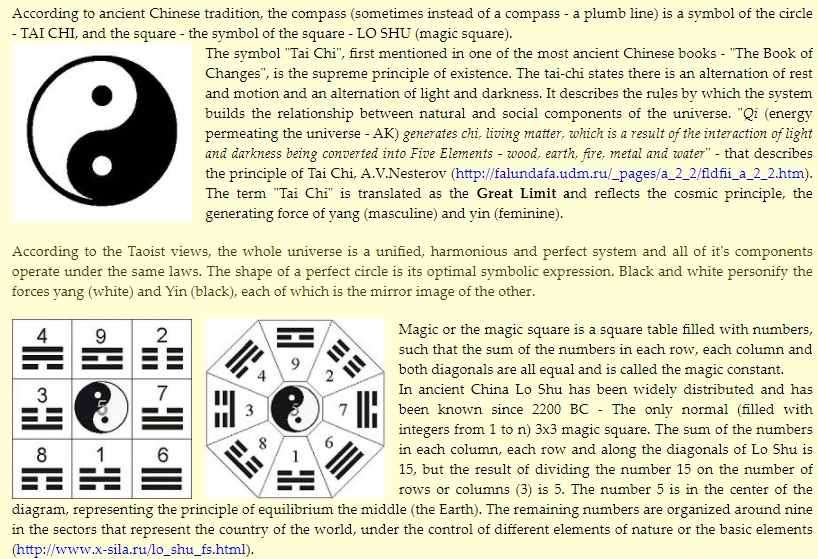
Fuxi found inspiration from the river map. He regarded the undivided universe as Tai Chi. This Tai Chi is not static. When Tai Chi starts to move, movement is yang, and static is yin. The difference between yin and yang will be two. instrument. Based on this, Fuxi drew the Tai Chi diagram, using the outer large circle to represent the universe of yin and yang, while the Tai Chi fish, which symbolizes yin and yang, chases and rotates in a clockwise direction.
Luoshu was developed on the basis of Hetu. It also uses black and white dots to form single and double numbers, but Luoshu only uses nine numbers. Luo Shu puts the singular number of yang in the positive direction, which means "four positives", which symbolizes the four solar terms of winter solstice, summer solstice, vernal equinox, and autumnal equinox. At the same time, the double digits of yin are placed between every two positive directions. Out of the four directions of northeast, southeast, southwest, and northwest, it is the "four corners", which symbolizes the four solar terms of beginning of spring, beginning of summer, beginning of autumn and beginning of winter. The combination of these symbols represents the circulation of the year.
In addition, whether the nine numbers are added horizontally, vertically, or diagonally, the sum obtained is fifteen. This wonderful balance, which symbolizes the transformation of yin and yang movement, will break the balance, but will eventually return to the overall balance. This is exactly the internal operation law of the universe after its formation, so Luoshu is also known as the "image of the acquired universe".
Fuxi created the innate gossip based on the river map, and Zhou Wenwang created the acquired gossip based on the Luo Shu. The gossip is actually an illustration of the universe by which the ancients further scientifically their understanding of the universe. Therefore, the gossip not only contains the laws of the universe, but also embodies the eight natural phenomena in the universe and the tens of thousands of changes resulting from them. Among them, Xiantian gossip mainly reflects the generation and evolution process of everything in the universe, while acquired gossip reflects the development and evolution of everything. Therefore, if you want to predict the macroscopic trend of the world, you mainly use Xiantian gossip; and deduce your personal fortune and family. Fate must focus on acquired gossip. In the geomancy, Feng Shui masters often use these two kinds of gossip in a comprehensive way, and grasp the law of changes in things according to the basic information in them.
The results of Zhou Wenwang's deduction of "Luoshu" are mainly acquired gossip. Except for the number "five" in the middle, there is no hexagram image. The eight hexagram images of the Houtian Eight Diagrams represent the eight digits of Luoshu, namely, one for ridge, two for Kun, three for earthquake, four for Xun, six for dry, and seven. For redemption, eight for Gen, and nine for Li. These eight numbers respectively represent the elements with yin and yang attributes, and they are mutually reinforcing and restraining each other, and can achieve the balance of things in the order of one to nine. At the same time, the Houtian Bagua starts the year with the east corresponding to the earthquake as a symbol of spring. From the beginning of the earthquake, eight hexagrams were arranged clockwise, corresponding to a complete year from spring to winter.
Houtian gossip uses its circulation cycle to show the balance benefits created by changes in things and time cycles. The geomantic work carried out by Feng Shui masters is precisely to pursue this balance and harmony. Therefore, Hou Tian gossip has also become an important tool for Feng Shui masters to study Feng Shui. .
The mystery contained in the Hetuluo book is organized according to the contents of Teacher Zhang Cheng's WeChat public account (Dacheng Zhidao Guoxue).
Basics of Yiyi|Hetu Luoshu, Congenital and Acquired Bagua and Human Nervous System
Zhouyi Qi Mentangmp 2019-02-28 22:53
"Hetu" and "Luoshu" are the source of Chinese culture. "Yi Xi Cishang" said: "He produces pictures, Luo publishes books, and saints do." This saint is Fuxi, the ancestor of human culture. Legend has it that at the time of the Fuxi clan, a dragon and horse appeared from the Yellow River and carried the "River Picture"; a supernatural tortoise appeared from Luoshui and carried the "Luoshu". Fuxi drew eight trigrams based on such "pictures" and "books." Later, King Wen also studied the eight trigrams of King Wen and the sixty-four trigrams based on Fuxi eight trigrams, and wrote the hexagrams respectively.
Hetu and Luoshu are two mysterious patterns handed down in ancient China. They have always been considered the origins of Heluo culture. Hetu and Luoshu are the sources of Chinese culture and the five elements of Yin and Yang. Confucian scholars in the Han Dynasty believed that Hetu was the Eight Diagrams, and Luoshu was the "Hong Fan Jiuchou" in Shangshu. Hetu and Luoshu were first recorded in "Shangshu", and secondly in "Yi Zhuan". There are many records in hundreds of scholars. Tai Chi, Bagua, Zhouyi, Liujia, Jiuxing, Feng Shui, etc. can all be traced to this point.
"Yi ·XiCiShang" has: " He produces pictures, Luo publishes books, and the saints do it " . The two books "Zhou Yi" and "Hong Fan" have an important position in the history of Chinese cultural development, and have had a profound influence in the fields of philosophy, politics, military science, ethics, aesthetics, and literature. As the origin of Chinese history and culture, Hetu Luoshu has contributed a lot. Source and Trace
"Zhouyi" originated from Fuxi's Eight Diagrams, and Fuxi's Eight Diagrams originated from "Hetu" and "Luoshu". In the Song Dynasty, the great scholar Zhu Xi listed "He Tu" and "Luo Shu" in his book "The Original Meaning of Zhou Yi" for the first time, and placed the pictures at the head of the volume. Nine is the river diagram and ten is Luo. Book. Most scholars in later generations believed that Zhu Xi's "He Tu" and "Luo Shu" originated from Chen Tuan, a Taoist priest in the Song Dynasty, and Zhu Xi was derived from Chen Tuan's words. Zhu Xi gave a simple explanation of the development process of "He Tu" and "Luo Shu", saying: "The image of books came from Kong Anguo, Liu Xin, and Wei Guan Langzi in the Han Dynasty. There were Mr. Song Kangjie and Shao Yongyao in the Ming Dynasty. Until Liu Mushi changed his name twice, and because of this, all the schools have restored it today, and learn from the old one.” Zhu Xi said, but in the Qing Dynasty, scholars Huang Zongxi and Hu Wei gave Song Confucianism "hetu" and " "Luo Shu" said all raised objections. Since then, "Hetu" and "Luoshu" have become a mystery that has been controversial for a long time in academia for thousands of years.
"Hetu" and "Luoshu" to find traces
What were the original shapes of "Hetu" and "Luoshu"? With the passing of the centuries, it is difficult for people to find the truth today, but judging from the remnants of historical records, its roots of wisdom are very ancient. In the initial period of mankind, according to some characteristics of natural objects, sages imitated the engraved on turtle backs and animal bones as an experience to warn people's survival. Because it is the accumulation of experience, it is often more efficacious. To a certain extent, it can turn people into auspiciousness. Later, it was gradually regarded by people as the auspicious thing of gods. We have unearthed a large number of oracle bone inscriptions from the Shang dynasty, mostly carved on tortoise backs and animal bones, and the content is mostly fortune-telling, which can be confirmed. The ancestors of China's distant ancestors admired tortoises and dragons, and there are many records in ancient myths and pre-Qin classics handed down. For example, "Zhuangzi·Xiaoyaoyou" writes: "There are ghosts in the south of Chu. Five hundred years old is spring, and five hundred years old is autumn." Most scholars here think that the "mingling" refers to the tortoise. In the book "Zhuangzi", the god tortoise is mentioned more than once, and it is also related to longevity and auspiciousness. Divine tortoises and dragon horses, snakes, deer, bears, scorpions, braves, braves, scorpions, tigers, and some flying birds, such as swallows, may be the totem worship of the ancestors of different tribes in the early days, and they are the logos of different tribes. Sima Qian has a record in his book "Records of the Five Emperors": "Emperor Yan wants to invade the princes of the mausoleum, and the princes will return to Xuanyuan. Xuanyuan cultivates virtue and revitalizes the army, governs the five qi, five kinds of arts, soothes the people, and saves the four directions. The bear, 罴, 貔, 貅, 貙, and tiger fought against the Emperor Yan in the field of Banquan, and won their aspirations after three battles." This is a battle between Emperor Yan and Emperor Huang in Banquan in Chinese history to fight for the Central Plains. The battle was fierce and cruel. The New Book · Yiyang claimed that the battlefield at that time was "bleeding and drifting", although there is an exaggeration. , But it can show that the war was really intense at that time. In this war, the Yellow Emperor was able to drive beasts such as bears and warriors to participate in the battle, adding a magical color to this war. These beasts were actually the totem worship of some tribes at that time. Different tribes followed the Yellow Emperor to participate in battles with their own distinctive clan logos. The Battle of Banquan ended with the victory of the Yellow Emperor. It led to the fusion of the Yan and Huang tribes, and the Chinese nation formally formed and developed into the main component of the Chinese nation. The Huangdi tribe is a tribe with dragon as its clan symbol. Therefore, the dragon later became a symbol of the Chinese nation. The myth of the "Battle of Banquan" is actually a record and explanation of the historical events of the battle between the Yan and Huang tribes at that time.
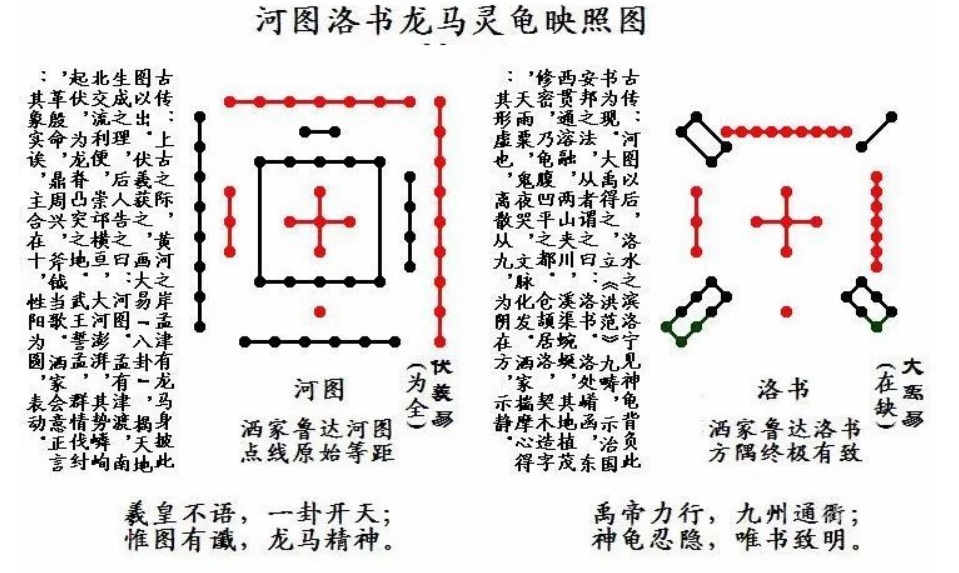
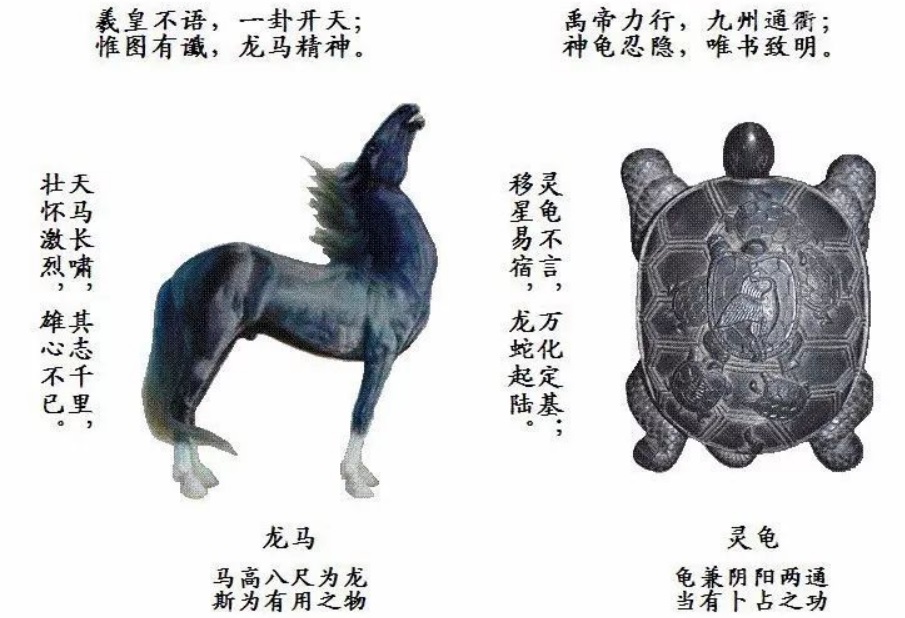
The "Hetu Luoshu" schema reflects the Chinese people's worship of numbers and the concept of time and space
Numbers are one of the important signs that humans first separated from the animal kingdom and became humans. The emergence of numbers has made human beings aware of their own wisdom and intelligence, and laid the foundation for the further development of wisdom. Philolaus, a thinker of the Pythagorean school of ancient Greece, once said: "Bigness, omnipotence, and perfection are the power of numbers. It is the beginning and master of human life, and a participant in everything. Without numbers, everything is chaotic and dark.” Therefore, humans in ancient times worshiped numbers very much from the beginning. This is a common feature of all nations in the world at the beginning of their cultural enlightenment. Ancient Chinese ancestors’ worship of numbers has a rich cultural content. On this issue, it can be said that the ancestors in ancient times have the knowledge of astronomy, geography, human relations, philosophy, art, primitive religion, daily life and so on. It is not difficult to understand this from the Song people's schematic understanding of the ancient book "Hetuluoshu".
The number worship of ancient Chinese ancestors is mainly manifested in the worship of the ten basic numbers from one to ten, as well as the worship of some numbers derived from the basic numbers after ten. Some numbers after ten are like twelve produced by multiplying two, two, and three, twenty-four produced by multiplying two, three, and four, twenty-eight produced by four-seven, and thirty-six produced by six-six. Forty-nine produced by seven-seven, sixty-four produced by eight-eight, eighty-one produced by ninety-nine, hundreds, thousands, and 10,000 produced by ten. In ancient Chinese cultural concepts, the ten basic numbers from one to ten are not just numbers with mathematical meaning, they also have aesthetic meaning, auspicious meaning, worldview and cosmological meaning, etc. Each basic number is a perfect number and auspicious number. , Ideal number, and great wisdom number, all have infinite meaning in detail.
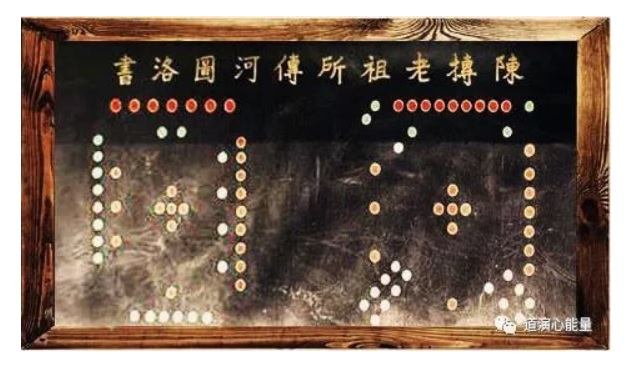
Hetu Luoshu and the nervous system
"Lu Note Compass Nine Emperors in volume by Dan" There are some within the volume: " is government land also, nine wearing a shoe, Panax as a belly to nine with a yang, twenty-four to the Heyang sixty-eight , For the shoulders and feet, to achieve the image of ninety-one, and Dutu Mansion is in the middle palace, and the five is to penetrate the collaterals of nine, one, two, four, six. The fifteenth number is connected to the fifty-five number, and the changes are intricate to achieve success. The avenue of three talents traverses the heavens and the earth, and connects the dantian's true qi. "
Liu Yiming in the Qing Dynasty had the following insights on the Luoshuhe map in his book "Zhouyi Explaining the Truth":
Luo Shu people, yin and yang are intricate, the five elements are in adversity, and there is a way to change.
When Dayu ruled the waters, a magical turtle came out of the Luohe River. His back had writings, nine writings near the head, one writing near the tail, three writings near the left rib, seven writings near the right rib, four writings near the left shoulder, two writings near the right shoulder, and six writings. Near the right foot, the eight texts are near the left foot, the five texts are in the back, and its position is nine, like the nine palaces, the middle five is like Taiji, and the middle one is like a chi; its shape is square, and the square is like the ground.
Luoshu, covering the principle of inverse countermeasures. The adversarial person uses the yin to overcome the yang and walks to the right. Therefore, the sergeant conquered northern water, northern water conquered western fire, western fire conquered southern gold, southern gold conquered eastern wood, and eastern wood conquered central soil. After the yin before the yang, the yin is static and the yang moves. Convergence is the work of gold and fire, fire is for refining, and gold is for punishment, so gold is in the position of fire, fire is in the position of gold, and gold and fire are in the same palace.
The golden fire has the wrong yin and the penis, and the water and wood yang does not move but the yin is wrong, the golden fire inhibits the water and the wood is angry. The positive of gram is the whole life, and the positive of the inverse leads to the shun. The wrong person is also confused. The yin and yang are disordered on the outside but restrained from each other. The summoner, the total rectification is also. The yin and yang are always integrated in the middle and grow in each other. There is a complex in the wrong, borrowing yin to rejuvenate the yang, and returning to the innate way in the day after tomorrow, don’t you care?
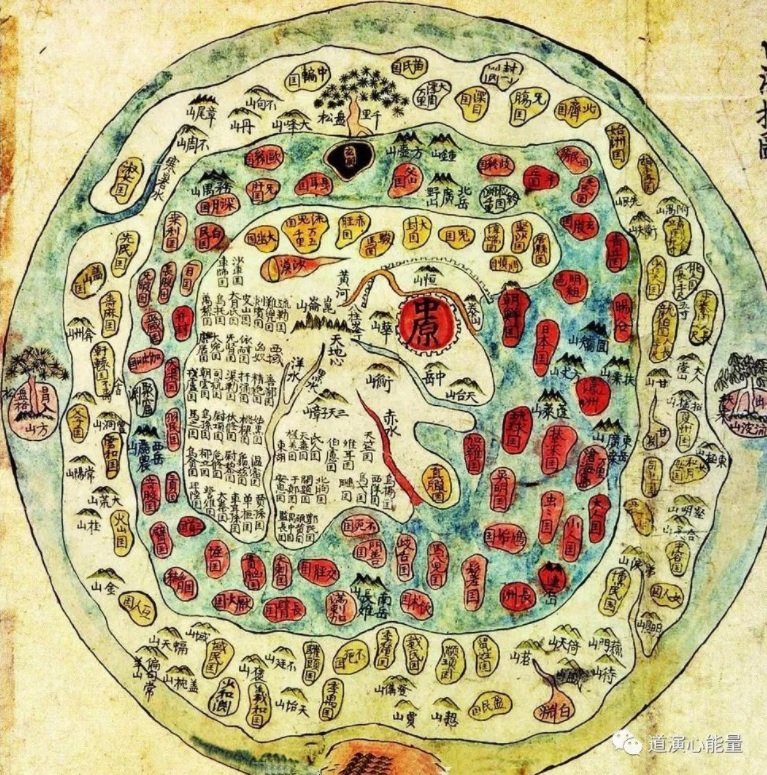
" Shan Hai Jing " Hetu Luoshu
Those in the river map, the five elements go straight, naturally do nothing. At the time of Fuxi, there was a dragon horse going out of the Meng River, with a bit of its back. Its position is five elephants and five elements, sixteen in the back, like northern Rengui water; twenty-seven in front, like southern Bing Ding fire; thirty-eight on the left, like eastern Jiayi wood; four-nine on the right, like western Gengxinjin; fifty In the middle, like the central Wuji soil. The middle five points are like Tai Chi containing four images; the middle one is like Tai Chi containing one energy. Although it's fifty-five o'clock, in fact two-five, two-five is actually one-five, and one-five is always one. Because it has five elements, it is divided into five points. Because the five elements have yin and yang, it accumulates as ten points. Because each of the five elements has yin and yang, it accumulates as fifty-five points.
Hole Chuan said: " Sky to two, three days four days five to six days and seven to eight or nine days to Tenth. " Build world's good fortune of the road, but a yang and yang, the five elements of a female, into a life of it . Although it is divided into five elements, one yin and one yang are actually used, although yin and yang are used, but one qi is used in exchanges. " Scholars of the past generations also have similar opinions:
1. Liu Mu's "Yi Shu Hou Yin Tu" says: " Five is the main one, six and eight are knees, two and four are shoulders, three on the left and seven on the right, and one wears nine shoes . "
2. Ren Shi's "Yi Xue" says: " Dai Jiulu, one on the left, three on the right, seven on the right, two and four for the shoulders, six and eight for the feet, five for the confidant, and fifteen in both vertical and horizontal directions . "
3. Xiyi Chen Boyun: "One wears nine shoes, one from the left, three from the left, seven from the right, two and four as the shoulders, six and eight as the feet, ten to five in vertical and horizontal directions, and five to forty in total . "
4. Zheng Qiao's "Six Classics Olympics" says: " Dai Jiulu, three left and seven right, two and four as shoulders, six and eight as feet, and five as the main theme . "
5. Li Jian's "Illustration of Learning the Book of Changes" says: " Dai Jiulu, one on the left, three on the left, seven on the right, two and four as the shoulders, six and eight as the feet, and five in the center . "
6. Zhang Li's "Depth Picture of the Great Yi Xiang Shu Hook" says: " Daily wears nine shoes, one on the left, three on the right, seven on the right, two and four for the shoulders, six and eight for the feet, and five for the abdomen . "
From the above various documents, the description of Luoshu is inseparable from the head, shoulders, heart, abdomen, flanks, knees and feet of the human body. However, most people use the Luoshu phrase "Dai Jiulu one, left three and right seven, two and four as shoulders, six and eight as feet, and five in the center", but He Tu does not mention the human body, and He Tu only uses friends, Daozong, etc. Character. (Picture 1)
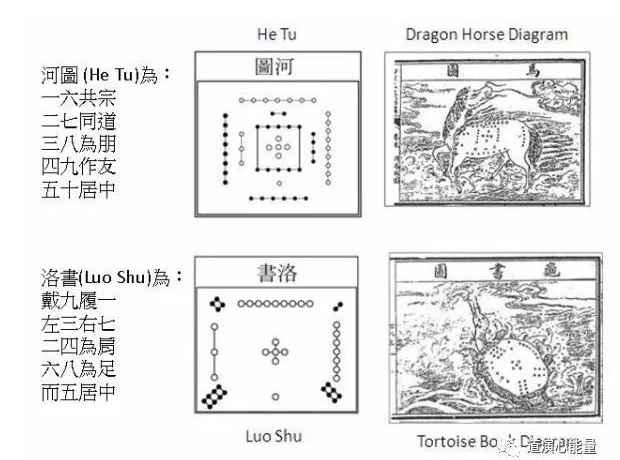
Hetu and Luoshu
So is there any relationship between Luoshu and the human body ? Before discussing this issue, let's briefly talk about the three-dimensional understanding of three dimensions in ancient China. In Cubism "Ancient Chinese Art" " _CNKI knowledge" national art 2002 Nian 04 for a text says:
" The "Cubism " of ancient Chinese art -most things in the world are three-dimensional, which is an objective existence that humans have been able to feel since ancient times... Cosmos schema China has had a view of the sky, the earth and the four directions as early as the ancient times. Knowing that, in the pre-Qin period, the four directions of heaven and earth were called "Liuhe", as used in "Zhuangzi ? Qiwu Lun"... " Baidu Baike also said: " Liuhe: upper and lower, east, west, south and north, namely the four directions of heaven and earth, which refers to the world or the universe . "
In addition, in the publication of " What Achievements in Ancient Chinese Mathematics ? " ( zhihu.com knows 2.16.2017 ), it was mentioned: " In terms of geometry, although ancient Chinese mathematicians would count many plane figures and three-dimensional figures ( However, the concept of (Cartesian) coordinate system has not been developed, so it has no connection with more powerful analytical geometry tools . ”
From our training experience, we most admire what Liu Yiming said to Luoshu in Qing Dynasty: “When the great Yu ruled the waters, a tortoise came out of the Luohe River, with writings on its back, nine writings near the head, one writing near the end, and three writings near the left rib. , Qiwen near the right rib, four words near the left shoulder, two words near the right shoulder, six words near the right foot, eight words near the left foot, five words in the back, its position is nine, like the nine palaces, the middle five is like Tai Chi, and the middle one is like One spirit; its shape is square and square like ground " .
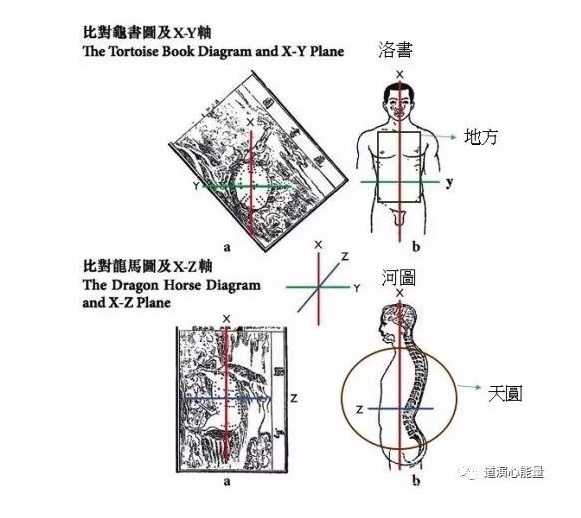
Ancient China likes to use code words and metaphors, especially in Taoist inner alchemy, the terms dragon, tiger, lead, mercury, etc. are often used to represent certain phenomena during practice. So if Ma map and chart books turtle is a representative body, what explanation do ? We can use Cartesian coordinates to answer, turtle book figure XY plane and human XY plane is the same, while Ma map XZ coordinate and The XZ coordinates of the longitudinal section of the human body are the same. The above can prove that the Dragon Horse and Turtle Script are the ancients deliberately used these two pictures to represent the plane and longitudinal section of the human body. (Figure 2A, 2B )
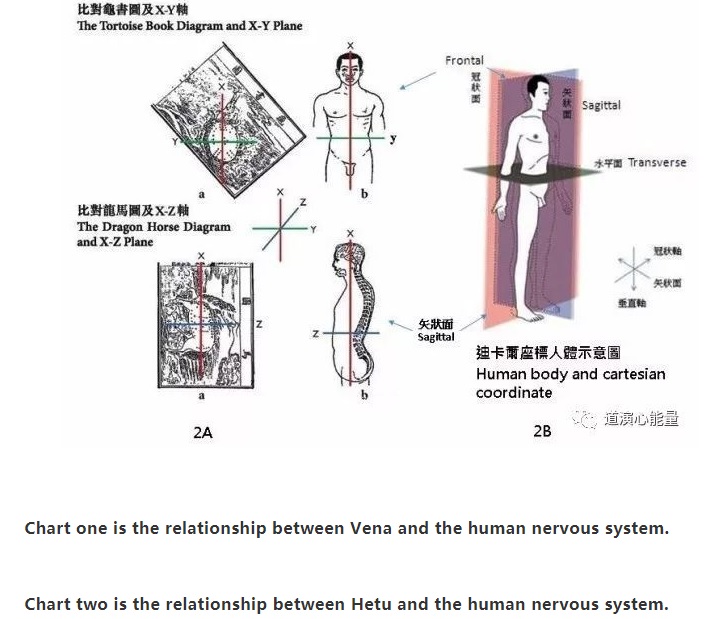
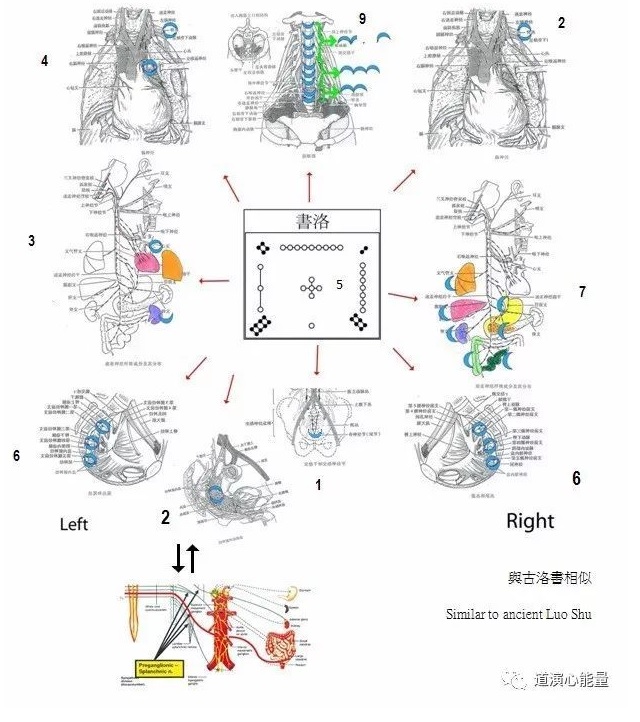
Vena and the nervous system
1. Odd-numbered ganglia.
2. Stellate ganglia.
3. The three viscera are related to the vagus nerve-heart, lung and kidney.
4. Stellate ganglion (left) and cardiac plexus.
5. T5-T9 Dantian is ( 5 ) or pancreas ( 5 ).
6. Right sacral nerve 1-5 , and right coccyx nerve.
7. Seven viscera are related to vagus nerve fibers-lung, liver, gallbladder, stomach, large intestine, small intestine, kidney.
8. Left sacral nerve 1-5 , left coccyx nerve 1 and mesenteric ganglion ( 2 ).
9. Esophageal plexus, tracheal plexus and seven cervical nerve lines.
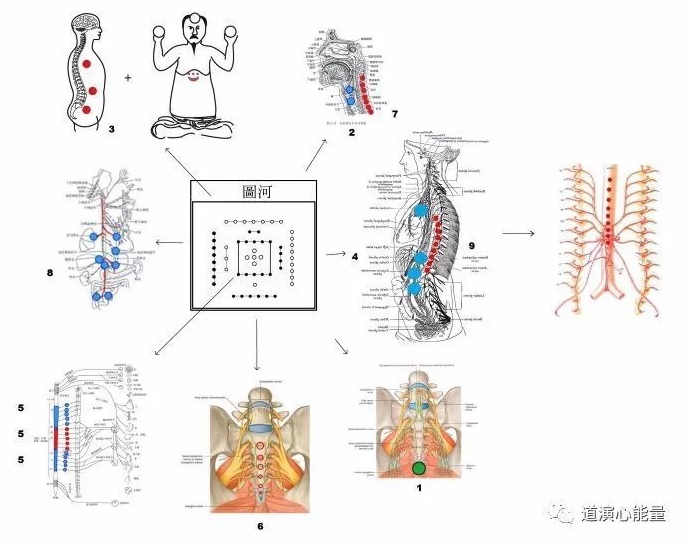
River diagram and nervous system
1. Odd ganglia? Coccygeal Plexus ( S2-S5-Co Coccygeal Plexus ).
2. Esophageal plexus and tracheal plexus.
3. Triple focal or parasympathetic nerve-heart, abdomen and pelvis.
4. Deep heart plexus, celiac ganglia, superior mesenteric ganglia, and inferior mesenteric ganglia.
5.T 1 -L3 sympathetic total of fifteen, is not in response to Hetu it?
6. The first to fifth sacral nerves and tail nerves? Sacral Plexus ( L4-S4 Sacral Plexus ).
7. Seven cervical nerves C1-C7 .
8. Eight viscera or vagus nerve.
9. Visceral nerves T5-T9 , T10-T11 , T12 and L1 (aorta).
discuss:
1. The ancient book said that the river map is the innate, and the Luo book is the acquired day (Figure 3). From the ancient Chinese concept of the sky and the round place, the Luo book is a square representing the earth, and the river map is the sky, which is round. From the point of view of the nervous system, especially the sympathetic nervous system, the points in Luoshu are dominated by peripheral nerves, while the He diagram is dominated by ganglia (plexes) or sympathetic trunks, so the points in the He diagram are close to the central nervous system. Taoist Qi practiced from the peripheral nervous system and then into the central nervous system.
2. In ancient China, the upper, lower, left, right, front and back, and Liuhe were used to represent the three-dimensional three-dimensional, while the Taoist used Luo Shu to represent the coronal plane of the human body, while the dragon horse represents the sagittal plane. Unfortunately, the Taoist lingo is not appreciated by ancient scholars, otherwise, China Ancient scholars will soon appreciate the principle of Cartesian coordinates.
3. From the above, we can see the views of the feudal age, especially in the society where Confucianism is dominant, the number of skills is not very welcome, plus the secret teaching of masters and apprentices, it is impossible to get the speed of progress and invention like the current public society.
4. The above discussion on Hetu and the Luoshu in particular has proved that Hetu and Luoshu have a direct relationship with the nervous system, so Hetu and Luoshu are indirect representatives of the human body.
5. The development of yin and yang and the five elements in ancient China is related to electromagnetic fields and biological organs or molecular structures. Chinese acupuncture and moxibustion theory is based on meridians and veins. All these are related to the Qi and the nervous system. Therefore, the tortoises in Luoshu cannot be derived from Water, and the dragon and horse in the river map cannot come from the sky, so Heluo is the representative of the two planes of the human body.
Sixth, because the master and apprentice passed on, the others became more and more complicated, and there were many mistakes.
Conclusion: From ancient times to the present, the words of Luoshu are inseparable from the parts of the human body, so we think that Luoshu represents the peripheral nerves of various parts of the human body, and the Hetu represents the autonomic nervous system and others. As for other mathematical explanations, different people have different opinions. NS.