This Blog is an Open Resource Containing Links, Commentary, Back Ups, and Research Into a Wide Variety of Topics and How They Can Connect to the Modern World: Alchemy, Astronomy, Astrology, Archeoastrology, Egyptology, Etymology, Gematria, History, Isopsephy, Numerology, Esoteric Knowledge, Occult, Magic, Gnosticism, and Many More. This blog features materials protected by the Fair Use guidelines of Section 107 of the Copyright Act. All rights reserved to copyright owners.
Here are some theories and information I've collected that I think are very interesting. This isn't to be provocative, but it is to make you think. I've always been told that we don't know the origins of the Genesis story and I've just accepted that in the past. But now I am realizing something isn't right.
pervigil ecce draco iquamis erepitantibus horrens
Latin for:
awake, behold, a dragon, shivering with bursting forth from the ice
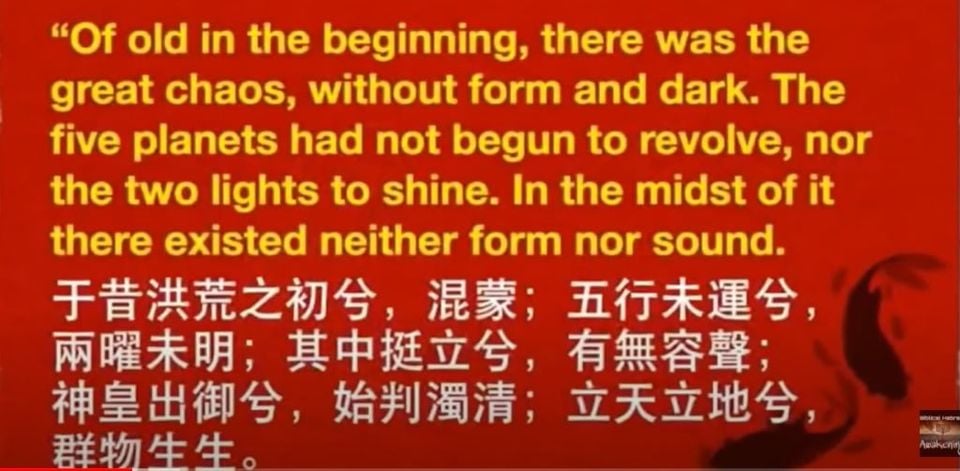
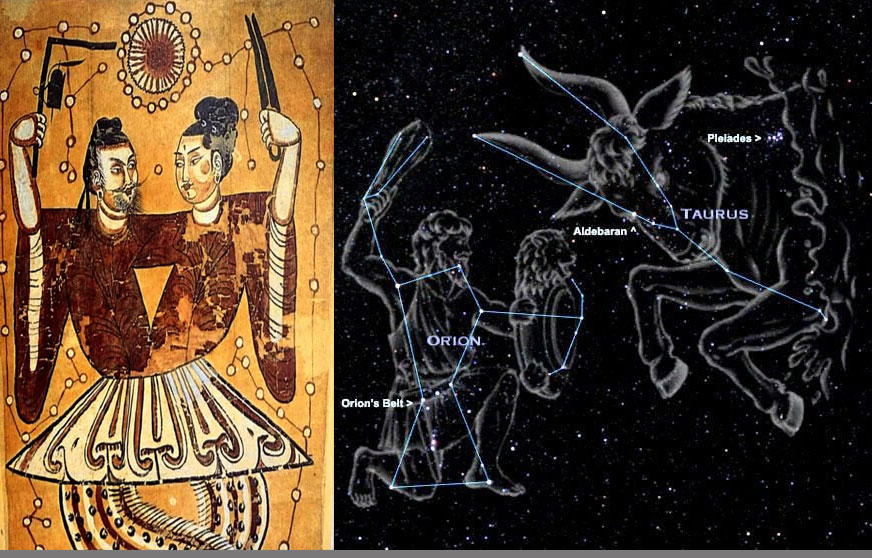
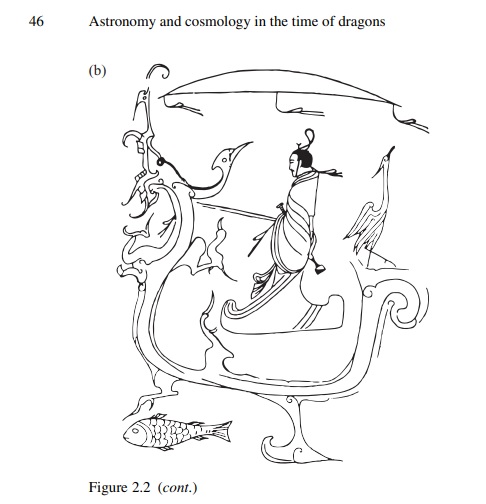
I find this question fascinating. Did the story of Genesis originate in Indochina?
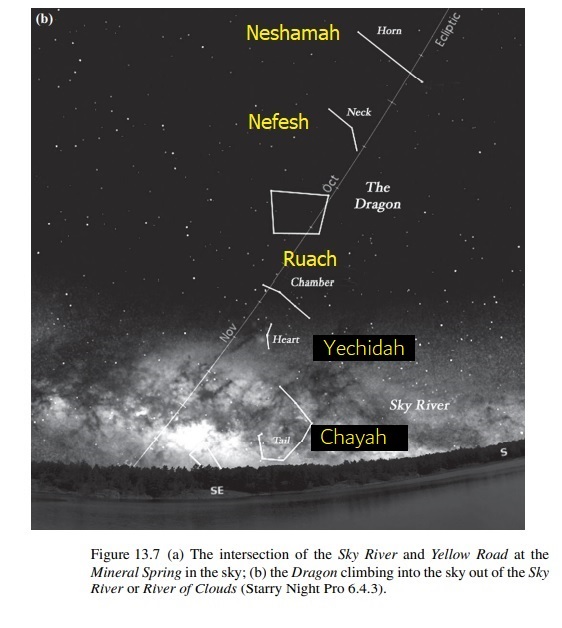
(image source: Astrology and Cosmology in Early China - David W. Pankenier, yellow text inserted)
Neshamah - Horn - Mind
Nefesh - Neck - Instincts
Ruach - Lung - Emotions
Yechidah - Heart - Oneness
Chayah - Tail - Bridge to Transcendence
Chayah means life (as in Chi) but it is used to define the length and end of a person's life repeatedly in Genesis.
The 543rd word in the Bible is אלהים (Elohim) when the LORD God made every tree in the garden, including the tree of life (Gen 2:9). The term "the tree of life" (ועץ החיים) has a gematria value of 239, the 52nd prime number.
Jesus said, I am the light of the world (Joh 8:12). On the first day of Creation, God created light, and separated the light from the darkness. The first day of Creation is described in Gen 1:1-5.
there are 52 Hebrew words in these first five Bible verses
Nahash is the word translated as "serpent" in Genesis.
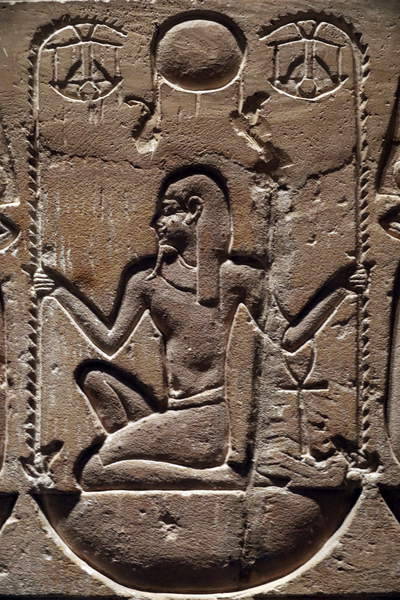
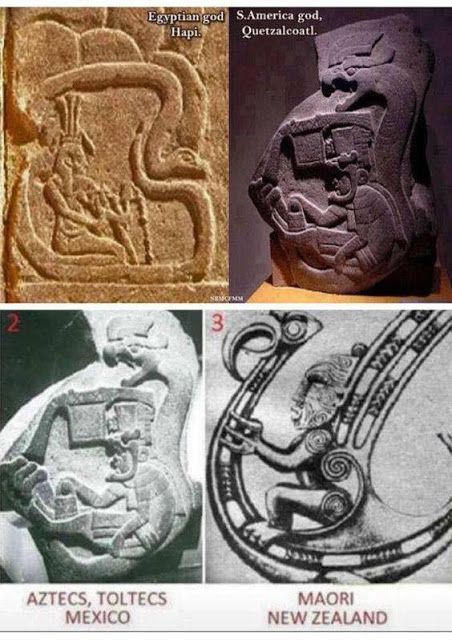
The lanterns are serpent eyes lighting the path, protecting the Egyptian god Heh. This is a charmed serpent, pressure has been applied to the top of his head (by Ra) to keep him calm. Heh is riding in the mouth, and HEH represents the breath, the spoken word.
This is "the way" to control yourself by looking at the dichotomy (opposing sides) - both extremes - and calming your mind.
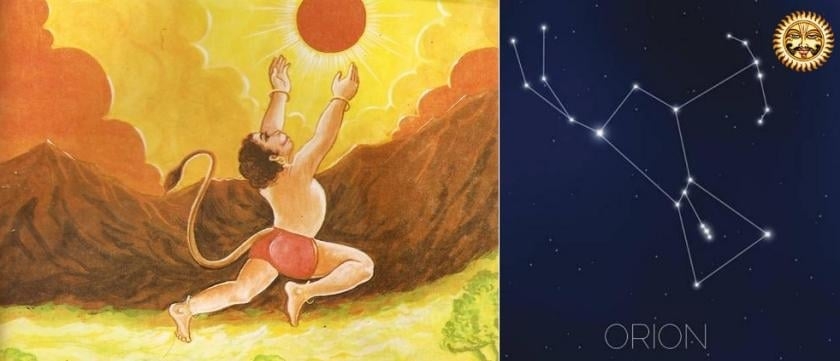
The meaning or origin of the word "Hanuman" is unclear. In the Hindu pantheon, deities typically have many synonymous names, each based on some noble characteristic, attribute, or reminder of a mythical deed achieved by that deity. One interpretation of the term is that it means "one having a jaw (hanu) that is prominent (mant)". This version is supported by a Puranic legend wherein baby Hanuman mistakes the sun for a fruit, attempts to heroically reach it, is wounded and gets a disfigured jaw.[10]:31–32
A second, less common interpretation is that the name derives from the Sanskrit words Han ("killed" or "destroyed") and maana (pride); the name implies "one whose pride was destroyed". This epithet resonates with the story in the Ramayana about his emotional devotion to Rama and Sita. He combines two of the most cherished traits in the Hindu bhakti-shakti worship traditions: "heroic, strong, assertive excellence" and "loving, emotional devotion to personal god".[10]:31–32
A third conjecture is found in Jain texts. This version states that Hanuman spent his childhood on an island called Hanuruha, which served as the origin of his name.[10]:189
In the Hindu pantheon, deities typically have many synonymous names, each based on the noble characteristic or attribute or reminder of that deity's mythical deed.[10]:31–32 Hanuman has many names like Maruti, Pawansuta, Bajrangbali, Mangalmurti but these names are rarely used. Hanuman is the common name of the vaanar (semi-ape, semi-man) god.
Linguistic variations of "Hanuman" include Hanumat, Anuman (Tamil), Hanumantha (Kannada), Hanumanthudu (Telugu). Other names include:
Anjaneya,[20] Anjaniputra (Kannada), Anjaneyar (Tamil), Anjaneyudu (Telugu), Anjanisuta all meaning "the son of Anjana"
Kesari Nandana or Kesarisuta, based on his father, which means "son of Kesari"
Vayuputra/ Pavanputra : the son of the Vayu deva- Wind god
Vajrang Bali/Bajrang Bali, "the strong one (bali), who had limbs (anga) as hard or as tough as vajra (diamond)"; this name is widely used in rural North India
Sankata Mochana, "the remover of dangers, hardships, or hurdles" (sankata)
Māruti, "son of Maruta" (another name of Vayu deva)
Kapeeshwara, "lord of monkeys"
Rama Doota, "the messenger (doota) of Lord Rama"
Mahakaya, gigantic"
Vira, Mahavira, "most valiant"
Mahabala/Mahabali, "the strongest one"
Panchavaktra, "five-faced"
Mukhya Prana Devaru, "Primordial Life Giver" (more prominent amongst followers of Dvaita, such as Madhwas) Some added source
The 7 words parallel the 7 words in the beginning verse of Torah, and the 12 words parallel the 12 closing verse of Torah, which have been well established by the rabbis.
The original 5 books of Torah therefore represent the revealed Torah, and the new 7 books of Torah would represent the concealed Torah that is yet to be revealed.
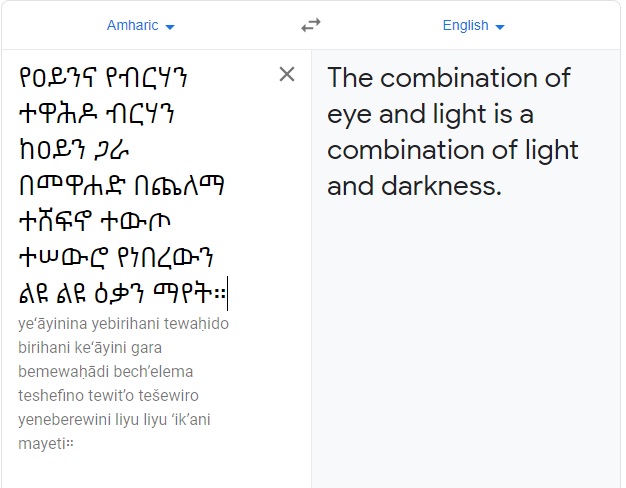
Written Torah is written down in order for the eyes to see, this is represented by letter Ayin, meaning “eye”.
Oral Torah is the teaching of Torah by mouth, this is represented by letter Peh, meaning “mouth”.
The fact that Ayin precedes Peh in the Alphabet comes to teach us that Written Torah is primary and Oral Torah is secondary.
The union of Written Torah and Oral Torah therefore is represented by the union of letter Ayin and letter Peh, which union is in 150.
Pharisees and Sadducees
The secret of the five (5) breads and seven (7) breads are the same, they are revealed as the “leaven of Pharisees and Sadducees” (Mat 16:11).
Pharisees and Sadducees represent the two opposite extremes on the subject of Oral Torah.
Pharisees accept all Oral Traditions by faith, this is one extreme of Torah study.
Sadducees reject all Oral Traditions and only accept the plain and simple meaning of the Torah, this is the other extreme of Torah study.
The Torah study as taught by Yeshua the Mashiach is to reconcile the two dichotomies, by studying both Oral Traditions as well as the plain and simple meaning of the Torah, such that the truth can be clarified by the works of the Holy Spirit...
dichotomy: a division or contrast between two things that are or are represented as being opposed or entirely different. For example, exists vs. non-existant. Light vs. Darkness. Good vs. Evil. etc.
The Pharisees and the Sadducees were Jewish schools of thought.
"For I tell you that unless your righteousness surpasses that of the Pharisees and the teachers of the law, you will certainly not enter the kingdom of heaven." Matthew 5:20
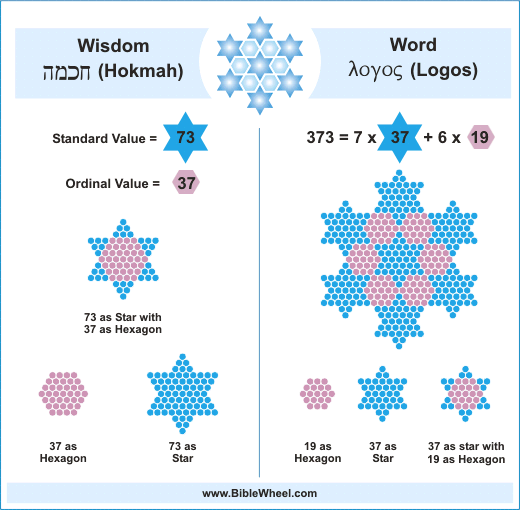
The number 373 (the word, Logos) is the 74th prime number.
the gematria value of אלהים (Elohim) is 86
the first occurrence of 86 in pi begins from position 74
the following three digits are 208
the 208th word in the Bible is להאיר ("to give light") when God set the great lights in the firmament of heaven to give light upon the earth (Gen 1:16-17)
Genesis 1
16 And God made two great lights; the greater light to rule the day, and the lesser light to rule the night: he made the stars also.
17 And God set them in the firmament of the heaven to give light upon the earth
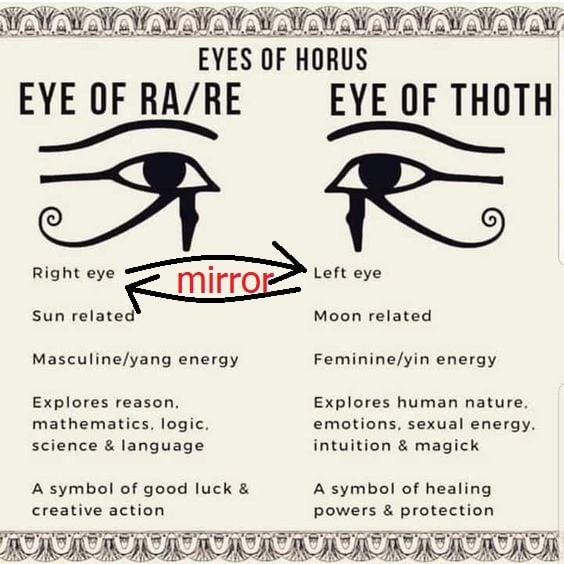
A few comments. The "Eyes of Horus" and the "Eye of Thoth" are not necessarily correct in this image. The Eye of Thoth (which would actually be YOUR right eye in a reflected mirror image) is the Eye of Horus. In the middle should be "The eyes of Ra-Horakhty" which is translated as Ra (who is) Horus of the Horizons. I've seen it also translated as the same but as "...of the Two Horizons". The eyes are symbolic of the yin/yang, the sun/moon relationship. Osiris is the father and Horus is the son, leaving Ra as the Holy Spirit, or mother. Sekhmet is also known as "the eye of Ra".
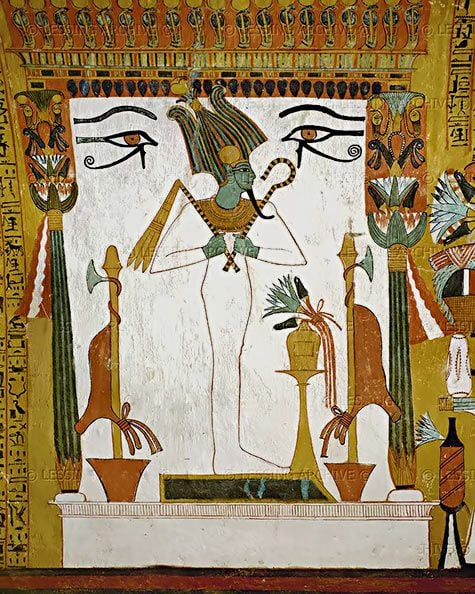
Notice the eye of Horus is "seated" at the right side of the father , the almighty "One" (Osiris). Horus is associated with the moon, breathing, and the tides. This could be the reason that Jesus (a later interpretation of Horus by Christians) is known as "the breath of life". His true nature is being a light in the darkness, like the moon.
The eyes are the hieroglyph of the bird, and the swirls are the wings symbolizing flight. This 'power' to see from both sides (dark and light) gives you the abilities of flight (intelligence, knowledge, wisdom, otherwise known as critical thinking).
The Supreme Mathematician (Jesus Christ) led me to another major discovery, which actually ties the first 19 Fibonacci numbers to the very foundation of Biblical Numerics (Genesis 1:1) even further. The Fibonacci number series naturally entails a process of TWO'S whereby we take any number in the series and add it with the previous number to get the next in line (and on to infinity). Using the same logic of "summing by two's", I was able to crack another numerical code that unites Genesis 1:1 with the first 19 Fibonacci numbers. When we take the digits that make up the Genesis 1:1 word values and sum their order as TWO digit integers, we get the sum of the first 19 PRIME NUMBERS (568):
Here is what is interesting about 568 - it gives you the five angles found within a perfect five pointed star.
I am using what's called "prime factorization sums" to get the columns and rows. After that, I am just cross multiplying. Then adding the values to get the sums in the columns and rows.
0, 72, 144, 216 (or 576 minus 360 degrees, a full circle), and 288.
You also, coincidentally, end up with the approximate radius of the moon in miles, 1080. That also happens to be the number of degrees if you went around a circle 3 times (or 360 x 3).
2368 and the first nineteen Fibonacci numbers, and prime factorization
2368 can be obtained by adding all the prime factorization numbers from F(2) to F(19). If F(1) is included, the number is one away. But - if you were to consider that God is 1 (the Lord is One), then you would have the Father (1) and the Son (2368).
F(0) = 0
F(1) = 1
--------
F(2) 1 = 1
F(3) 2 = 2
F(4) 3 = 3
F(5) 5 = 5
F(6) 8 = 2x2x2
F(7) 13 = 13
F(8) 21 = 7x3
F(9) 34 = 2x17
F(10) 55 = 5x11
F(11) 89 = 89
F(12) 144 = 2×2×2×2×3×3
F(13) 233 = 233
F(14) 377 = 13x29
F(15) 610 = 2×5×61
F(16) 987 = 3×7×47
F(17) 1597 = 1597
F(18) 2584 = 2×2×2×17×19
F(19) 4181 = 37×113
I am just adding up every number on the right side, all the prime factors from the beginning to the end.
Try pronouncing the three words and see how similar they sound. How is that possible?
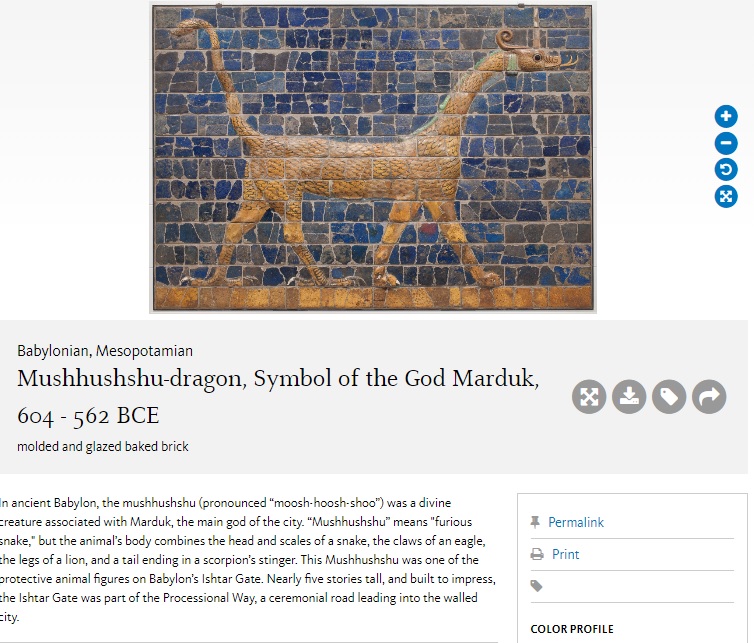
Note on wikipedia: Similar to the Set animal in Egyptian mythology and the Qilin in Chinese mythology.
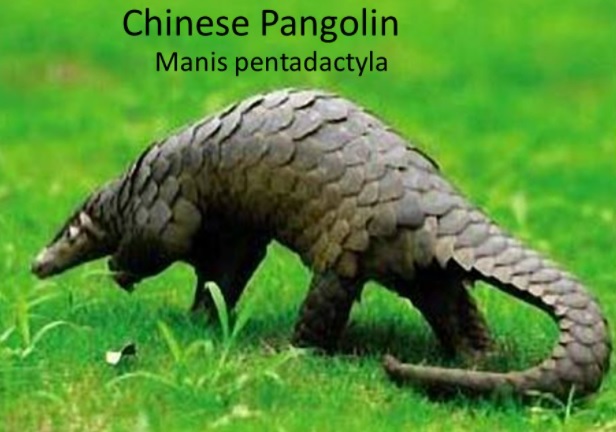
Possible comparison to similar animal in Chinese "mythology":
Pg 6. Shanhaijing
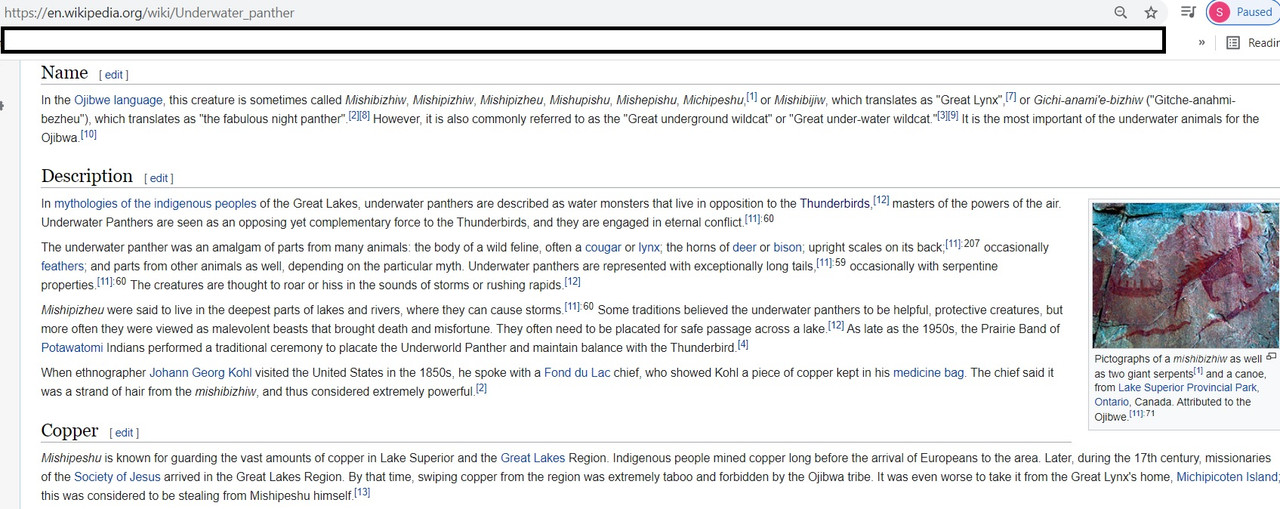
Name
In the Ojibwe language, this creature is sometimes called Mishibizhiw, Mishipizhiw, Mishipizheu, Mishupishu, Mishepishu, Michipeshu, or Mishibijiw, which translates as "Great Lynx", or Gichi-anami'e-bizhiw ("Gitche-anahmi-bezheu"), which translates as "the fabulous night panther". However, it is also commonly referred to as the "Great underground wildcat" or "Great under-water wildcat." It is the most important of the underwater animals for the Ojibwa.
Description
Pictographs of a mishibizhiw as well as two giant serpents and a canoe, from Lake Superior Provincial Park, Ontario, Canada. Attributed to the Ojibwe.
In mythologies of the indigenous peoples of the Great Lakes, underwater panthers are described as water monsters that live in opposition to the Thunderbirds, masters of the powers of the air. Underwater Panthers are seen as an opposing yet complementary force to the Thunderbirds, and they are engaged in eternal conflict.
The underwater panther was an amalgam of parts from many animals: the body of a wild feline, often a cougar or lynx; the horns of deer or bison; upright scales on its back; occasionally feathers; and parts from other animals as well, depending on the particular myth. Underwater panthers are represented with exceptionally long tails,: occasionally with serpentine properties. The creatures are thought to roar or hiss in the sounds of storms or rushing rapids.
Mishipizheu were said to live in the deepest parts of lakes and rivers, where they can cause storms. Some traditions believed the underwater panthers to be helpful, protective creatures, but more often they were viewed as malevolent beasts that brought death and misfortune. They often need to be placated for safe passage across a lake. As late as the 1950s, the Prairie Band of Potawatomi Indians performed a traditional ceremony to placate the Underworld Panther and maintain balance with the Thunderbird.
When ethnographer Johann Georg Kohl visited the United States in the 1850s, he spoke with a Fond du Lac chief, who showed Kohl a piece of copper kept in his medicine bag. The chief said it was a strand of hair from the mishibizhiw, and thus considered extremely powerful.
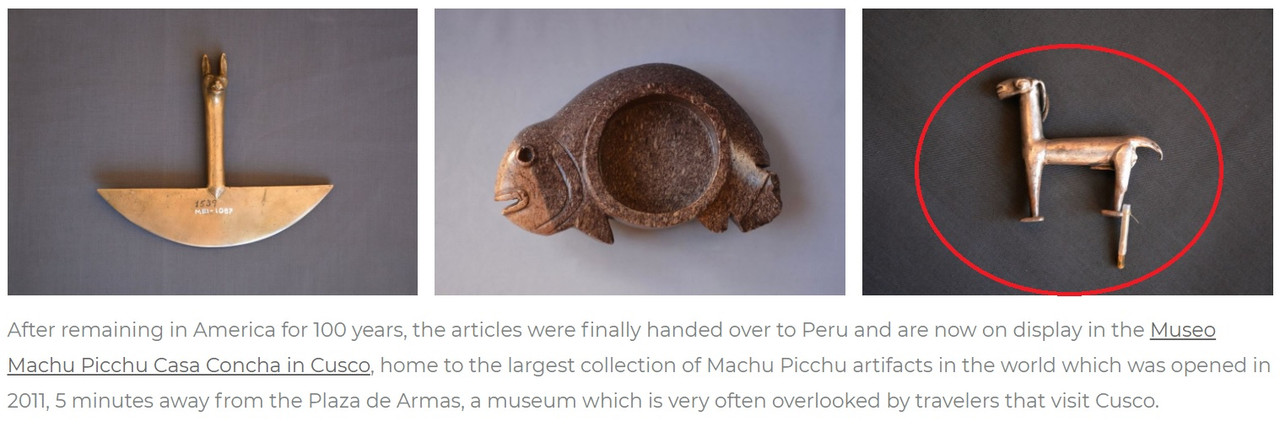
This is symbolic of a llama, but notice the similarity in artwork. For comparison, some mongolian dragons representative of the two dragons battling in the Chinese constellations.
Machu Picchu Etymology
In the Quechua language, machu means "old" or "old person", while pikchu means either "portion of coca being crunched" or "pyramid, pointed multi-sided solid; cone".[15] Thus the name of the site is sometimes interpreted as "old mountain".
Used to be called Patallacta (Quechua expression that expresses 'city on high'), also known as Q'entimarka (city of hummingbirds) is an archaeological site located in Cusco, in the Inca Trail route. The complex is located in the Cusco region, Urubamba province, Machu Picchu district.
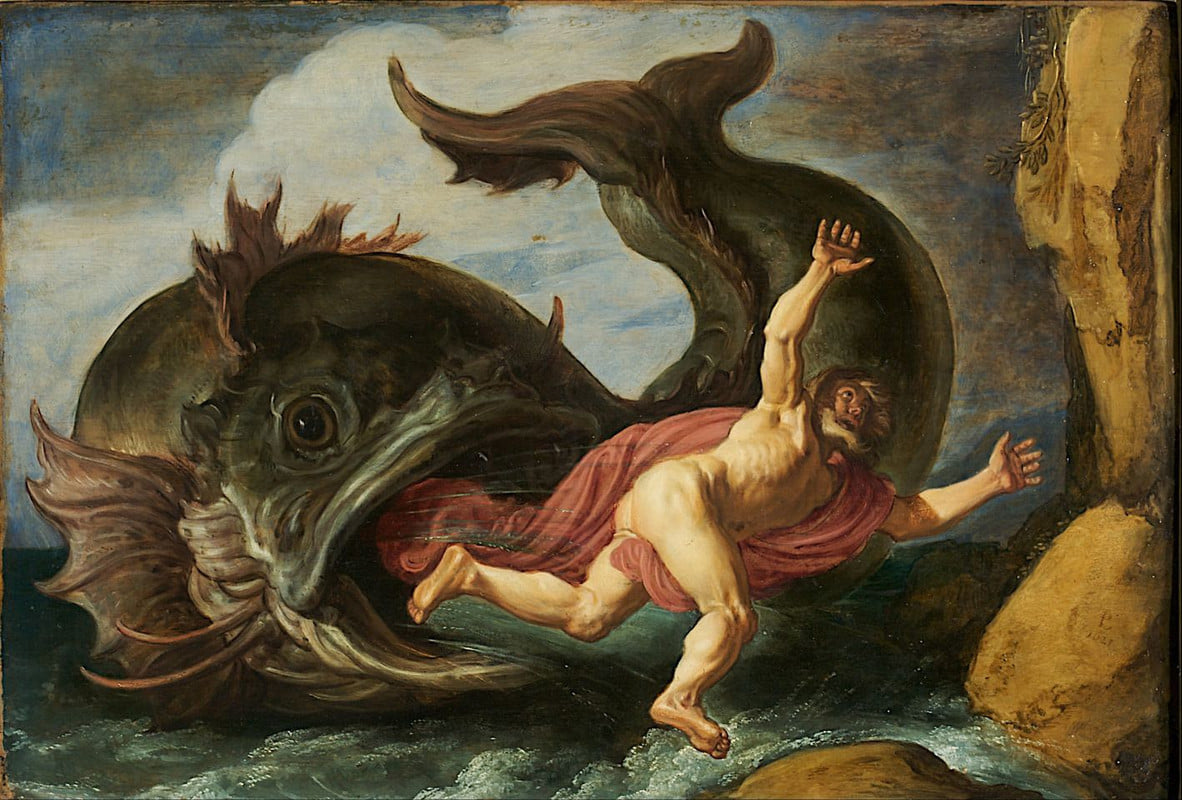
The story of Jonah - what is the relationship between a dragon and a whale?
What is the signficance of a whale and a dragon? Were whales and sea monsters part of ancient myths? What about fire and air and it's apparent connection to the breath of life? Could ancient people have building hot air balloons? Is this art depicting Chinese systems of belief? How do you explain the Nazca lines? Is it all documented in artifacts and ignored and suppressed? Is it just that some people remain ignorant of different cultures? So many more questions.