Plutarch's Morals: Theosophical Essays, tr. by Charles William King, [1908], at sacred-texts.com
The following excerpts from The Rosicrucians: Their Rites and Mysteries by Hargrave Jennings [4th ed., 1907][first published 1870]
The writer, who goes by the name of Dionysius Areopagita, teaches that the highest spiritual truth is revealed only to those who have transcended every ascent of every holy height, and have left behind all divine lights and sounds and heavenly discoursing, and have passed into that Darkness where HE really is (as saith the Scripture) who is ALL, above all things.
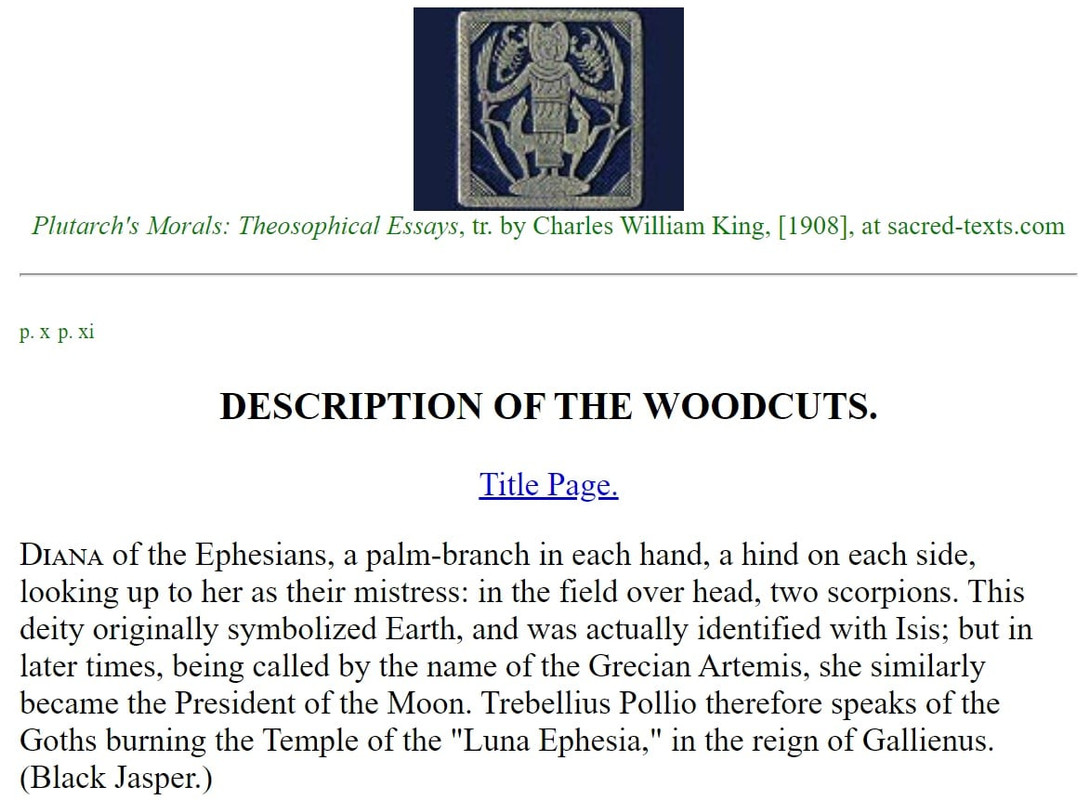
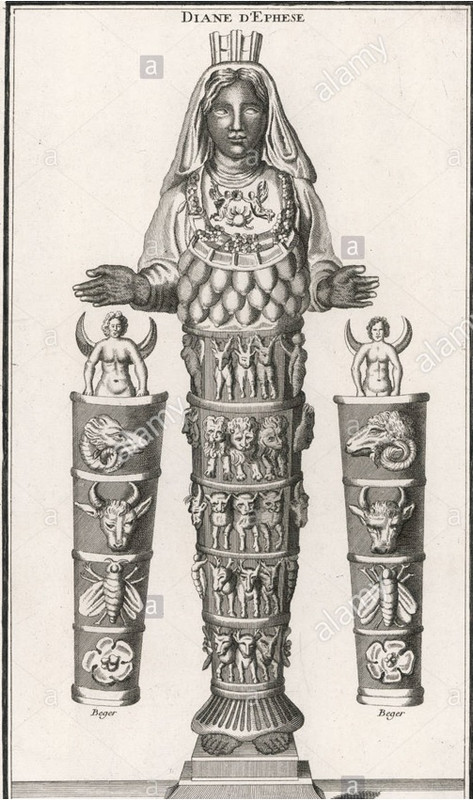
The words graven upon the zone and the feet of the Ephesian Diana, which Hesychius has preserved, are the following:
Aski-Kataski = 'Darkness--Light'
Haix-Tetrax = 'Himself'
interpreted as
Damnameneus = 'The Sun'
Aision = 'Truth'
'These Ephesian words', says Plutarch (Sympos), 'the Magi used to recite over those possessed with devils.' 'Damnameneus' is seen on a Gnostic amulet in the De la Turba Collection (The Gnostics, p. 94).
The Argha had the form of a crescent. The Argo, arc, or arche, is the navis biprora. It is clear that, as neither the full moon nor the half-moon was ever the object of worship, it is the crescent horns of the moon which imply the significance. These mean the woman-deity in every religion.
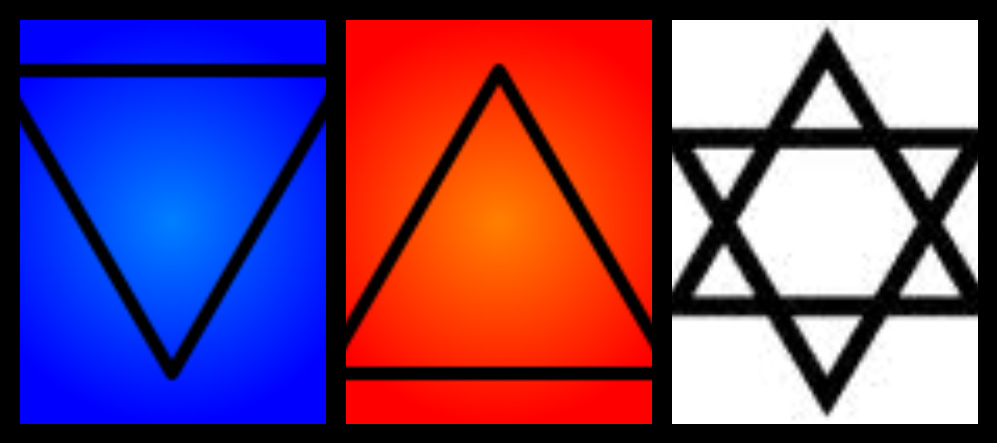
The snake associated with the mysteries among the Hindoos is the cobra-di-capella. It is said that the snake on the heads of all the Idols in Egypt was a Cobra. The name of the monarch or Chief Priest in Thibet is the Lama, or the Grand Lama. Prester-John is the great Priest, or Prestre (Prêtre), Ian, Ion, Jehan, or John (the Sun). Lamia is the 'snake' among the Ophidians; Lama is the hand: lamh, hand, is a divine name in the Scythian tongue. It also means the number 10, and the Roman numeral X, which is a cross. Now, the double pyramid, or hand, (a) △, of the Egyptians comprises the mystic mark signifying the two original principles water and fire, as above--(b)--the union of which, as intersecting triangles, forms the famous Hexalpha, or 'Solomon's Seal', or 'Wizard's Foot', which, according to the Eastern allegory, is placed (as that of St. Michael) upon the Rebellious Spirits in their 'abyss', or 'prison'.
Pyr is the Greek name of fire (thence Pyramid), and mythologically of the sun, who was the same as Hercules. And the great analyser of mythology assures us that Pur was the ancient name of Latian Jupiter, the father of Hercules; that he was the deity of fire; that his name was particularly retained amongst the people of Præneste, who had been addicted to the rites of fire. Fire, in short, in these mythologies, as also in all the Christian churches, meets us at every turn. But we must not mix up heathen ideas and Christian ideas in these matters.
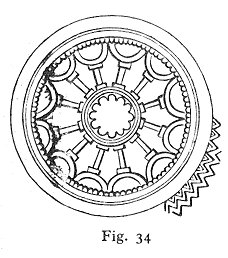
OUR engraving borrows from the West Front of Laon Cathedral, France, a Catherine-Wheel (or 'Rose') Window. The twelve pillars, or radii, are the signs of the Zodiac, and are issuant out of the glorified centre, or opening 'rose'--the sun, or 'beginning of all things'. 'King Arthur’s Round Table' displays the 'crucified' Rose in its centre.
In the 'tables' (Tablier, Fr. = Apron), alternating with tying-knots, of the Order of the Garter--which 'Most Noble Order' was originally dedicated, be it remembered, to the Blessed Lady, or to the Virgin Mary--the microcosmical, miniature 'King Arthur’s Round Table' becomes the individual female discus, or organ, waxing and waning, negative or in flower, positive or natural, alternately red and white, as the Rose of the World: Rosamond, Rosa mundi. And here we will adduce, as our justification for this new reading of the origin of the Order of the Garter, the very motto of the princely order itself: Honi soit qui mal y pense!
or,
'YONI' soit qui mal y pense!
What this 'Yoni' is, and the changes meant and apotheosized through it, the discreet reader will see on a little reflection.
All the world knows the chivalric origin of this Most Noble Order of the Garter 1. It arose in a princely act--rightly considered princely, when the real, delicate, inexpressibly high-bred motive and its circumstances are understood, which motive is systematically and properly concealed. Our great King Edward the Third picked up, with the famous words of the motto of the Order of the Garter, the 'garter'--or, as we interpret it, by adding a new construction with hidden meanings, the 'Garder' (or special cestus, shall we call it?)--of the beautiful and celebrated Countess of Salisbury, with whom, it is supposed, King Edward was in love.
The following is from Elias Ashmole: 'The Order of the Garter by its motto seems to challenge inquiry and defy reproach. Everybody must know the story that refers the origin of the name to a piece of gallantry: either the Queen or the Countess of Salisbury having been supposed to have dropped one of those very useful pieces of female attire at a dance; upon which old Camden says, with a great deal of propriety, and a most just compliment to the ladies, "Hæc vulgus perhibet, nec vilis sane hæc videatur origo, cum NOBILITAS sub AMORE jacet." The ensign of the order, in jewellery or enamel, was worn originally on the left arm. Being in the form of a bracelet to the arm, it might possibly divert the attention of the men from the reputed original; it might be dropped and resumed without confusion; and the only objection I can see to the use of such an ornament is the hazard of mistake from the double meaning of the term periscelis, which signifies not only a garter, but breeches, which our English ladies never wear: "Quæ Græci περισχελῆ vocant, nostri Braccas" (braces or breeches) "dicunt", says an ancient Father of the Church.' The Garter, to judge thus from Camden, was not a garter at all for the leg, but an occasional very important item of feminine under-attire; and King Edward's knightly feeling, and the religious devotion of the object, will be perceived upon close and delicately respectful consideration. There is great obscurity as to the character of Abraxas, the divinity of the Gnostics. The Eons, or Degrees of Advance in the Zodiacal Circle, are thirty in number to each of the Twelve Signs, and consequently there are 360 to the entire Astronomical Circle, or 365, counting for each day of the solar year. The inscription upon the Gnostic gems, CΕΟΥ, is probably intended for ΘΕΟΥ; 'for the Arabs yet substitute the s for the th in their pronunciation' (Gnostics, p. 233; Matter, Histoire Critique du Gnosticisme). In this 's', and the 'th' standing for it, lie all the mysteries of Masonry.
+, Christos, was designed for the guide of all that proceeds from God. Sophia-Achamoth is the guide, according to the Gnostics, for all proceeding out of 'matter'. St. Irenæus, whose period is the end of the second century, draws all these startling inferences from the Book of Enoch, and names 'Sophia' as signifying the Divine Wisdom. The Ophite scheme seems evidently the Bhuddistic Bythos, answering to the first Buddha. Sige, Sophia, Christos, Achamoth, Ildabaoth, answer to the successive five others (Gnostics,
p. 181
p. 27; Bellermann’s Drei Programmen über die Abraxasgemmen, Berlin, 1820; Basilides; Tertullian; De Præscript.: 'Serpentem magnificant in tantum, ut ilium etiam Christo præferant.' See Tertullian, Epiphanius, and Theodoret.: St. John iii. 14, also). We now refer the reader to some significant figures towards the end of our volume, which will be found according to their numbers.
Figure 289: The Abraxas-god, invested with all the attributes of Phœbus. Green jasper; a unique type. The Egyptians call the moon the mother of the world, and say it is of both sexes (Plutarch; Spartian, Life of Caracalla). The moon, in a mystic sense, is called by the Egyptians male and female. The above is a gem in the Bosanquet Collection. In the exerque is the address, CΑΒΑΩ, 'Glory unto Thee!' On the reverse, in a cartouche formed by a coiled asp--precisely as the Hindoos write the ineffable name 'Aum'--are the titles ΙΑΩ.ΑΒΡΑCΑΞ (The Gnostics, p. 86).
Figure 311 represents Venus standing under a canopy supported on twisted columns, arranging her hair before a mirror held up by a Cupid; two others hover above her head, bearing up a wreath. In the field, ΦΑΣΙΣ ΑΡΙΩΡΙΦ--'The Manifestation of Arioriph'. Venus here stands for the personification of the Gnostic Sophia, or Achamoth, and as such is the undoubted source of our conventional representation of Truth (Montfauçon, pl. clxi). Reverse, figure 312, which represents Harpocrates seated upon the lotus, springing from a double lamp, formed of two phalli united at the base. Above his head is his title 'Abraxas', and over that is the name 'Iao'. In the field are the seven planets. The sacred animals--the scarab, ibis, asp, goat, crocodile, vulture, emblems of so many deities (viz. Phre, Thoth, Isis, Merides, Bebys, Neith)--the principal in the Egyptian mythology, arranged by threes, form a frame to the design. Neatly engraved on a large, bright loadstone (The Gnostics, p. 211).
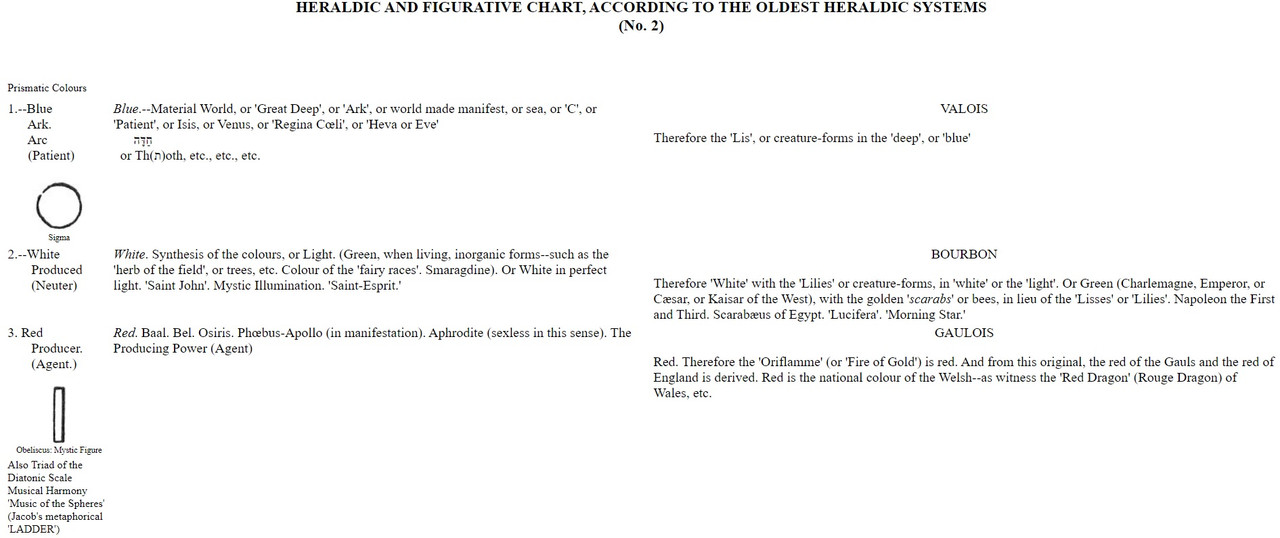
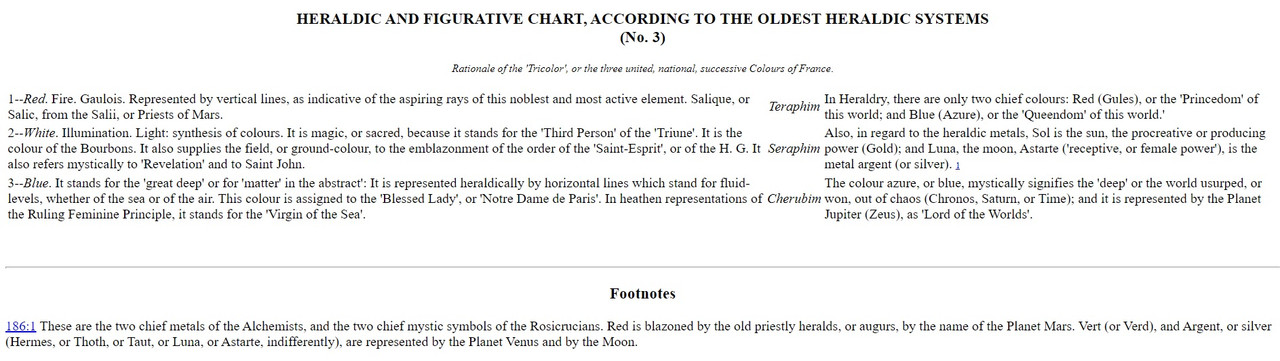
From the above cabalistic estimate of the virtues of colours, it happens that the colour blue (sky-blue) is chosen as the colour for the investiture of infants at baptism, and as the colour for children's coffins. Blue or white (not white as meaning the 'S.S.' in the sacred sense, but white as the synthesis of material elements, or of light, or of 'sinlessness in irresponsibility') are children's colours at other times. There were two great ordeals--by water, and by fire. The one is the occult trial-baptism by water in the sinister or left-handed sense, applied to those suspected of witchcraft. The other (more perfect and more perfecting) baptism is by symbolical fire. Both rites were in use among the Egyptians. (Refer to mystic heraldic formulæ elsewhere in our book.) The three ordeals (or sacraments) of the Ancient Mysteries were by 'Water, Air, and Fire'. Thus, also, the Egyptian Initiations: 'Cave, Cloud, Fire'. So, too, the Masonic Initiations. With these meanings, royal coffins and investitures are always red (Mars), as meaning 'royalty active'; or imperial purple (Jupiter, or perhaps Mercurius--Thoth, Taut, Tat), as 'royalty passive', or implying the 'lord of regions'.
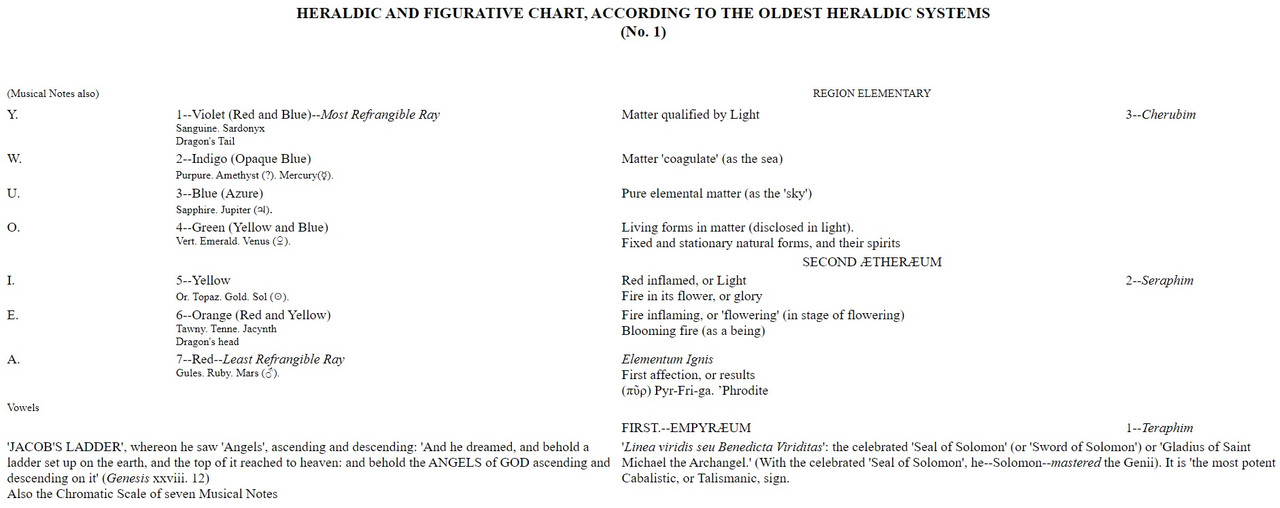
According to the cabalistic view, 'Jacob's 'Ladder', which was disclosed to him in a vision, is a metaphorical representation of the powers of alchemy, operating through visible nature. The 'Ladder' was a 'Rainbow', or prismatic staircase, set up between earth and heaven. Jacob's Dream implied a history of the whole hermetic creation. There are only two original colours, red and blue, representing 'spirit' and 'matter'; for orange is red mixing with the yellow light of the sun, yellow is the radiance of the sun itself, green is blue and yellow; indigo is blue tinctured with red, and violet is produced by the mingling of red and blue. The sun is alchemic gold, and the moon is alchemic silver. In the operation of these two potent spirits, or mystic rulers of the world, it is supposed astrologically that all mundane things were produced.
The next following pages explain the mystic analogy between colours, language; music, and the seven angelic adverse intelligences, supposed by the Gnostics to be operative in the 'dissonance of creation'. These represent the descending half of the 'Machataloth', as the cabalistic Jews called the Zodiac united. The whole is made up from abstruse sigmas, or the application of Rosicrucianism on its hieroglyphic and representative side.